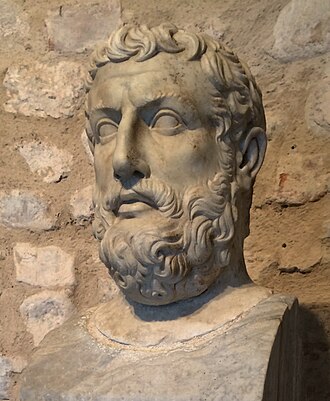
Born in Elea, a Greek colony in southern Italy, and active in the first half of the fifth century BCE, Parmenides is the founder of ontology — the inquiry into being as being — and the greatest figure of the so-called Eleatic school. He expounded his thought in a philosophical poem, On Nature, of which fragments survive: in it, a young man is carried in a chariot to a goddess who reveals the truth to him.
The goddess presents two paths. The way of truth (alētheia), trodden by reason, sets out from an absolute principle: “being is, and non-being is not.” To think nothingness is impossible, for to think is always to think something that is. The way of opinion (doxa), trodden by the senses, is that of mortals, who believe in a world of change and multiplicity.
From the pure affirmation of being, Parmenides draws radical conclusions: being is one, eternal, immobile, indivisible, and complete, resembling a perfect sphere. For if anything came to be, it would come from non-being — which is impossible; therefore birth, death, and all the change the senses show are mere appearance. This thesis, directly opposed to that of Heraclitus, posed once and for all the problem of the relation between being and becoming. Defended by the paradoxes of his disciple Zeno of Elea, it influenced the immutable Forms of Plato and the principle of non-contradiction of Aristotle. One might say that, with Parmenides, philosophy discovered the power — and the dangers — of pure reason, capable of flatly contradicting the testimony of the senses in the name of logical coherence.
Key Concepts
- “Being is; non-being is not”
- Two paths: truth (reason) vs. opinion/error (senses)
- Being: eternal, immobile, one, homogeneous
- Negation of becoming on the plane of being
Influenced by
- Xenophanes (one and immobile God)
- Pythagoras (philosophy as a path of purification)
Influenced
- Zeno of Elea — disciple; defends Parmenides through paradoxes
- Plato — eternal and immutable Forms; dialogue Parmenides
- Aristotle — principle of non-contradiction
- Plotinus — the One as pure being
Works
Poem On Nature (fragments in Simplicius, Commentary on the Physics).
See also
Pre-Socratics and Sophists