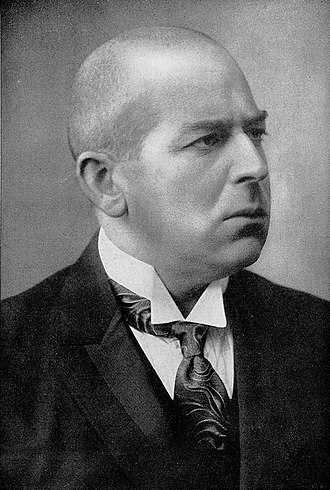
Oswald Arnold Gottfried Spengler (1880–1936) was born in Blankenburg, Germany, the son of a postal official. He trained in mathematics and natural science, taught briefly at secondary level, and then devoted himself entirely to writing as an independent author in Munich. His magnum opus, The Decline of the West (Der Untergang des Abendlandes), published in two volumes — Form and Actuality (1918) and Perspectives of World History (1922) — turned him almost overnight into one of the most discussed authors of interwar Europe: the first volume appeared just months before Germany’s defeat in the First World War, and its title seemed to prophesy the collapse then under way.
Against the linear historiography inherited from the Enlightenment — which saw human history as continuous progress toward reason and civilization — Spengler proposed a “comparative morphology” of history: the great cultures (he names eight “high cultures”: Babylonian, Egyptian, Chinese, Indian, Classical Greco-Roman, “Magian” or Arabian, Western or “Faustian,” and Mexican) are organisms that are born, mature, and die according to an internal cycle analogous to that of a plant, not according to a single teleology common to all of humanity. Each culture possesses its own untranslatable “soul,” expressed in its mathematics, architecture, music, and religion. Western culture, which Spengler calls “Faustian” for its aspiration to the infinite, would have been born around the year 1000 and had already passed its creative peak, entering the stage he calls Zivilisation.
Key Concepts
- The Kultur/Zivilisation distinction: Kultur designates the creative, organic phase of a high culture, when it still generates original forms in art, religion, and thought; Zivilisation is the terminal, urban, technicist stage, devoid of metaphysical creativity, in which a culture crystallizes into empire, money, and mass society. For Spengler, the West had already entered this civilizational “autumn” since the nineteenth century.
- Comparative morphology of cultures: Spengler’s method of comparing distinct cultures far apart in time in search of structural “contemporaneities” — for example, between Greek mathematics and the mathematics of the early modern West — rather than establishing a single progressive chronology for all of humanity.
- Pseudomorphosis: the phenomenon whereby a young culture, still in formation, is stunted by the overwhelming presence of an older and more powerful culture, prevented from freely developing its own forms; Spengler applies the concept, for instance, to Russia confronting the modern West.
- Organic analogy: cultures, like living organisms, pass through phases equivalent to birth, childhood, maturity, and old age; decline is not an avoidable historical accident but the necessary fate of every cultural organism, just as winter follows autumn.
- Cyclical determinism and rejection of progress: Spengler rejects both the Enlightenment idea of linear progress and any religious teleology of history; for him, history has no single meaning or final direction, only the repeated — though never identical — rhythm of the birth and death of cultures.
Influenced by
- Goethe — Spengler’s morphological method derives explicitly from Goethe’s morphology of plants: grasping a living form “from within,” by intuition of the whole, rather than through analytical dissection
- Nietzsche — vitalism, the critique of decadence, and reading history as the expression of vital forces in ascent and decline
- Schopenhauer — metaphysical pessimism and the idea that life follows a tragic course indifferent to the reason that claims to govern it
- Early twentieth-century German vitalism and the Heraclitean emphasis on becoming and incessant flux
Influenced
- Arnold Toynbee — who takes up the project of a comparative morphology of civilizations, but expressly rejects Spengler’s biological determinism
- The interwar German “Conservative Revolution,” even though Spengler himself publicly broke with Nazism after 1933 — he came away unimpressed from his 1933 meeting with Hitler and was harassed by Alfred Rosenberg
- Longue-durée historiography and cyclical theories of civilization in the twentieth century
- Contemporary debates on civilizational decline and critiques of the universalism of progress
Works
Der Untergang des Abendlandes [The Decline of the West], vol. I, Form and Actuality (1918); vol. II, Perspectives of World History (1922); Prussianism and Socialism (1919); Man and Technics (1931); The Hour of Decision (1933).
See also
Nietzsche, Arnold Toynbee, Hegel, Schopenhauer