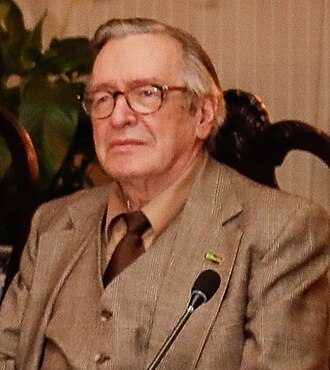
Olavo Luiz Pimentel de Carvalho was born in Campinas, São Paulo, on 29 April 1947, and died in Richmond, Virginia (USA), on 24 January 2022, days after testing positive for COVID-19. Self-taught and without a university degree, he built an extensive body of work outside the academy — more than forty books, plus thousands of articles and lectures — and became the Brazilian thinker with the greatest public influence in recent decades.
Career
He worked as a journalist from an early age. In the 1980s he devoted himself to astrology and to the traditionalist esotericism of René Guénon and Frithjof Schuon, and for some time belonged to the Sufi brotherhood (tariqa) linked to Schuon; he later broke with that current and became its critic. In the 1990s he published the trilogy A Nova Era e a Revolução Cultural (1994), O Jardim das Aflições (The Garden of Afflictions, 1995), and O Imbecil Coletivo (The Collective Imbecile, 1996), as well as the essay Aristóteles em Nova Perspectiva (1996). He was a columnist for major Brazilian newspapers. In 2005 he moved to the United States and, from 2009, taught the online Philosophy Seminar, which gathered thousands of students and trained much of the intellectual cadre of Brazil’s new right. He recommended people who went on to head ministries in the Bolsonaro government, such as Ernesto Araújo (Foreign Affairs) and Ricardo Vélez Rodríguez (Education).
Key concepts
- Theory of the four discourses — in Aristotle in a New Perspective, he argues that poetics, rhetoric, dialectic, and analytics are not separate disciplines but degrees of a single scale of human discourse, ordered by the credibility of their premises: from the possible to the plausible, the probable, and the certain.
- Cognitive parallax — the displacement between the axis of a thinker’s theoretical construction and the axis of his real experience; a philosophy that its own author could not live by would thereby reveal a defect at its root. He used the concept as a critical yardstick against Machiavelli, Descartes, Marx, and other moderns.
- Consciousness and intellectual responsibility — philosophy as the pursuit of “the unity of knowledge in the unity of consciousness,” not as academic specialization; the philosopher must answer personally for what he asserts.
- Critique of the cultural revolution — a reading of Gramsci and the Frankfurt School as a strategy for conquering hegemony in culture, the press, and the university, the theme of A Nova Era e a Revolução Cultural and The Collective Imbecile.
- Philosophy of history — in The Garden of Afflictions, starting from a seemingly minor episode, he reconstructs the formation of the modern secular project of power, from Epicurus to the contemporary state.
Reception and criticism
The reception of his work is sharply divided. His readers see him as the great renewer of high culture in Brazil, responsible for reintroducing authors such as Voegelin, Lavelle, and Mário Ferreira dos Santos into the national debate. Academic philosophy, by and large, does not treat him as an interlocutor and points to the polemical and unsystematic character of much of his writing; critics also highlight conspiratorial and anti-scientific positions he held on public issues, such as vaccines and the COVID-19 pandemic. His thesis on Aristotle, on the other hand, has recognized precedents in the Arabic commentary tradition (al-Farabi, Averroes) and is the part of his work most discussed in strictly philosophical terms.
Influenced by
- Aristotle and Plato
- Eric Voegelin and Louis Lavelle
- Mário Ferreira dos Santos
- René Guénon and Frithjof Schuon (traditionalist phase, later criticized)
Influenced
- Brazil’s new right and twenty-first-century Brazilian conservatism
- The reissue and reception of Mário Ferreira dos Santos and of conservative authors in Brazil
- Thousands of students of the Philosophy Seminar, among them writers, editors, and teachers
Works
A Nova Era e a Revolução Cultural (1994); O Jardim das Aflições (1995); O Imbecil Coletivo (1996); Aristóteles em Nova Perspectiva: introdução à teoria dos quatro discursos (1996); O Futuro do Pensamento Brasileiro (1997); Maquiavel, ou a confusão demoníaca (2011); O Mínimo que Você Precisa Saber para Não Ser um Idiota (2013, ed. Felipe Moura Brasil).
See also
Mário Ferreira dos Santos, Aristotle, Eric Voegelin, Antonio Gramsci