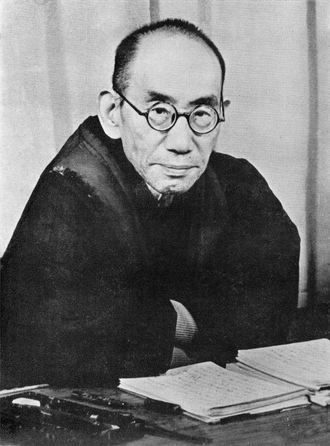
Note on romanisation: Japanese names are given in Hepburn romanisation, with the original characters in parentheses on first occurrence. Macrons (ō, ū) indicate long vowels. In the Japanese convention, the family name (Nishida) precedes the given name (Kitarō); the Japanese order is followed here, in keeping with current editorial practice for modern Japanese philosophers.
Nishida Kitarō (西田 幾多郎) is the founder of the Kyoto School and the most influential modern Japanese philosopher of the twentieth century. A Rinzai Zen practitioner from his youth — under the masters Setsumon and Kōshū — he was trained in philosophy at the Imperial University of Tokyo and lectured at Kyoto Imperial University, where he gathered around himself the generation that would give body to the so-called “school.” His project may be described as the attempt, without comparable precedent in modern Japan, to articulate Buddhist meditative experience with the vocabulary and rigour of European (chiefly German) philosophy — without reducing one to the other.
His work develops in phases: from the early concept of “pure experience” (in dialogue with William James) to the mature reformulation around basho, “place,” as a logical structure in which reality determines itself. Nishida’s engagement with Japanese nationalism during the Second World War is the subject of ongoing scholarly debate (see, among others, James Heisig, John Maraldo); his texts on the “historical world” and the idea of a “world order” are read as ambiguous rather than as plain adherence to militarism, but the question remains under discussion.
Key Concepts
Pure experience (junsui keiken, 純粋経験; Zen no Kenkyū, 1911): the starting point of Nishida’s thought. Prior to the split between subject and object, pure experience is the lived in act, before it is categorised; the avowed influence of William James (The Varieties of Religious Experience) is combined with Zen practice.
Self-awareness (jikaku, 自覚): the central topic of Jikaku ni okeru chokkan to hansei (1917). Not the Cartesian self-consciousness of the cogito, but the movement by which consciousness intuits and reflects upon itself — a structure rather than a content.
Basho (場所, “place”; especially from Hataraku mono kara miru mono e, 1927): the concept of his maturity. Basho designates not a physical place but the logical structure in which something is “given,” the field in which subject and object are inscribed. There is a hierarchy: basho of being, basho of relative nothingness, basho of absolute nothingness.
Place of absolute nothingness (zettai mu no basho, 絶対無の場所): the ultimate structure in Nishida’s logic. “Nothingness” here is not privative negation in the Western sense, but the non-objectifiable ground that makes any determination possible; it is the point at which Nishida articulates Buddhist categories (śūnyatā, mu) with Hegelian ones.
Absolutely contradictory self-identity (zettai mujunteki jiko dōitsu, 絶対矛盾的自己同一): in his late works, the formula with which Nishida describes the dynamic unity of the real, in which each being is what it is by being the tension of opposites.
Historical world (rekishiteki sekai, 歴史的世界): in the 1930s and 1940s Nishida develops a philosophy of history and action in which the subject is “the creative point of the world” — formulations whose political interpretation remains debated.
Influenced by
- William James — the notion of pure experience in the Essays in Radical Empiricism and the Varieties is openly at the source of Zen no Kenkyū
- Hegel — especially the Science of Logic; Nishida reads and rereads the Hegelian dialectic throughout his life
- Fichte and Schelling — for the notion of self-awareness and late German idealism
- Henri Bergson — for lived temporality and the critique of intellectualism
- Rinzai Zen — personal meditative practice, and the vocabulary of mu (無)
- Mahāyāna Buddhism — the prajñāpāramitā tradition and the notion of śūnyatā
Influenced
- Tanabe Hajime (1885–1962) — direct disciple; he will develop the “logic of species” in critical dialogue with Nishida
- Nishitani Keiji (1900–1990) — author of Shūkyō to wa nani ka (Religion and Nothingness), a central figure of the second generation of the Kyoto School
- The Kyoto School as a tradition — Ueda Shizuteru, Abe Masao, and the contemporary reception in the West
- Comparative philosophy and East-West dialogue — the institutional basis for engagement with Heidegger, Heinrich Rickert and phenomenology
Works
The inaugural work is Zen no Kenkyū (善の研究, An Inquiry into the Good, 1911), which articulates pure experience. There follow Jikaku ni okeru chokkan to hansei (1917), the set of essays collected in Hataraku mono kara miru mono e (1927; “From the Acting to the Seeing,” the explicit turn to the logic of basho), Ippansha no jikaku-teki taikei (1930), Tetsugaku no kompon mondai (“Fundamental Problems of Philosophy,” 1933–34), and the late essays on the historical world, gathered in the Nishida Kitarō Zenshū (“Complete Works of Nishida Kitarō,” in several editions).
See also
Heidegger; Husserl; Buda