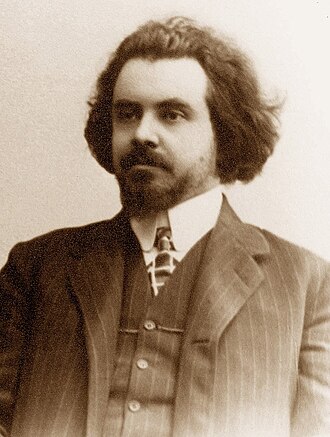
Nikolai Alexandrovich Berdyaev (18 March 1874, Kyiv — 24 March 1948, Clamart, France) was a Russian religious and political philosopher, often described as a “Christian existentialist.” Of aristocratic origin, he began as a Marxist — he was even internally exiled under the tsarist regime for his activities — but broke early with materialism toward idealism and Orthodoxy. He took part in the critical collection Vekhi (1909). Expelled from Soviet Russia in 1922, in the episode of the “philosophers’ ships,” he lived in Berlin and then in Clamart, near Paris, where he edited the journal Put and became the best-known voice of Russian thought in exile. He was nominated several times for the Nobel Prize.
Key Concepts
- Primordial freedom and the Ungrund: Berdyaev’s most original thesis. Freedom is not created by God but precedes him: it is rooted in the Ungrund, the “groundless abyss” prior to being, a concept he takes from the mystic Jakob Böhme. This uncreated freedom allows the origin of evil to be explained without making God responsible for it — a theodicy of freedom.
- Personalism: the person (lichnost) is the supreme category and the absolute value, irreducible to the biological individual or to the social unit. Berdyaev asserts the primacy of the person over society, the state, and every collective — the theme of Slavery and Freedom (1939).
- Creativity (tvorchestvo): the creative act is the central vocation of the human being and the continuation of divine creation. In The Meaning of the Creative Act (1916), Berdyaev sees in creativity the true human response to the image of God — not mere obedience, but active participation in the work of the world.
- Objectification (obyektivatsiya): the fall of spirit into the “objectified” world — the world of necessity, exteriority, and reification, opposed to the inner world of spirit and freedom. Knowing and socializing tend to objectify; the task is to recover the existential beneath the objectified.
- Philosophy of history and eschatology: in The Meaning of History (1923), he rejects the idea of indefinite progress and attributes to history an eschatological meaning, directed toward an end that transcends it. The New Middle Ages (1924) announces the end of the modern humanist-individualist era.
- Critique of communism and the bourgeois spirit: in The Origin of Russian Communism (1937), he interprets Bolshevism as the secularization of a typically Russian religious messianism. Berdyaev criticizes both bourgeois materialism and totalitarianism, in the name of the freedom of the spirit.
Influenced by
- Jakob Böhme — the Ungrund, abyssal freedom
- Kant — the distinction between phenomenon and freedom (read existentially)
- Dostoevsky — freedom and the problem of evil (the Legend of the Grand Inquisitor)
- Vladímir Soloviov — Russian religious philosophy
- Nietzsche and Kierkegaard — the critique of morality and existential pathos
- Marx — social analysis (in his early phase, later surpassed)
Influenced
- Emmanuel Mounier and French personalism (the journal Esprit)
- Twentieth-century Christian existentialism
- Orthodox thought in exile
- The Western reception of Dostoevsky as a philosopher
Works
The Philosophy of Freedom (1911); The Meaning of the Creative Act (1916); The Meaning of History (1923); Dostoevsky (1923); The New Middle Ages (1924); The Destiny of Man (1931); The Origin of Russian Communism (1937); Slavery and Freedom (1939); The Russian Idea (1946); Self-Knowledge (autobiography, posthumous, 1949).
See also
Vladímir Soloviov, Mikhail Bakhtin