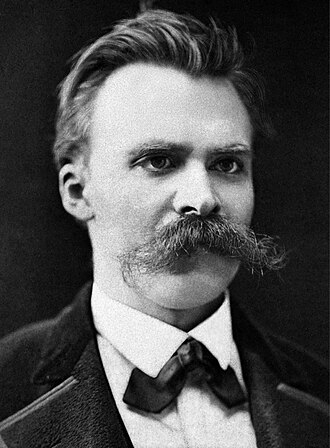
The son of a Lutheran pastor, Friedrich Nietzsche was born in Röcken, Prussia, in 1844. A precocious classical philologist, he became a professor at the University of Basel at the age of 24 — before he had even completed his doctorate. His admiration for, and later break with, the composer Richard Wagner, together with his fragile health, led him to give up the chair in 1879 and to live as a solitary wanderer through Switzerland and Italy, writing his most important books. In January 1889, in Turin, he suffered a mental collapse from which he never recovered: he spent his last eleven years incapacitated, and his unpublished work was in part distorted by his sister Elisabeth — even though Nietzsche himself had vehemently rejected German nationalism and antisemitism.
At the center of his thought lies a diagnosis: the “death of God.” By this Nietzsche announces no theological thesis but observes that the supreme values of the West — God, Truth, the Good in itself — have lost the power to orient existence, opening the age of nihilism. Through the genealogy of morals, he shows that these values have a history: the dominant, Christian-rooted morality is said to have arisen from the ressentiment of the weak against the strong — a “slave morality” that inverted the noble values, turning weakness into merit and vitality into sin.
But Nietzsche is not merely a critic; he is above all a thinker of the affirmation of life. To decadence he opposes the will to power (Wille zur Macht), an impulse of creation and self-overcoming — not of mere political domination — and the figure of the overman (Übermensch), capable of creating his own values after the twilight of the old ones. The eternal recurrence is the decisive test of that affirmation: to will one’s own life in such a way that one would wish to live it over again countless times, in full amor fati. His influence on the twentieth century was immense — from Heidegger and Sartre to Foucault and Derrida — marking existentialism, post-structuralism, and depth psychology.
Key Concepts
- Death of God: the supreme values of the West have lost their binding force — diagnosis of cultural nihilism
- Genealogy of Morals: Christian morality is morality of slaves — born from the ressentiment of the weak against the strong; inversion of noble values
- Will to Power (Wille zur Macht): fundamental impulse of expansion, creation, overcoming — not will to political domination
- Overman (Übermensch): one who creates his own values; man is “a rope over the abyss”
- Eternal Recurrence: the supreme test of life-affirmation — amor fati
- Revaluation of All Values (Umwertung aller Werte)
- Apollo vs. Dionysus (The Birth of Tragedy): form/order vs. excess/life
Influenced by
- Schopenhauer — irrational will (but inverts the pessimism)
- Wagner (early period; later rupture)
- Heraclitus — becoming and affirmation
- Spinoza — conatus as affirmation
Influenced
- Heidegger — question of being, critique of metaphysics
- Sartre and Existentialism — death of God, freedom
- Foucault — genealogy, power-knowledge
- Derrida — deconstruction of values
- Adorno — critique of mass culture
Works
The Birth of Tragedy (1872); Human, All Too Human (1878); The Gay Science (1882); Thus Spoke Zarathustra (1883–85); Beyond Good and Evil (1886); On the Genealogy of Morals (1887); Twilight of the Idols (1889).
See also
Nineteenth-Century Philosophy