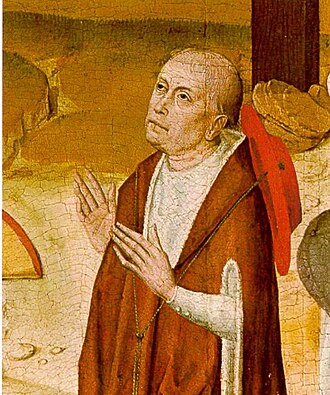
German cardinal; transitional figure between Scholasticism and the Renaissance. Used mathematics as a philosophical analogy (not as a method in the technical sense) to express the relationship between divine infinity and human finitude.
Born in Kues (present-day Bernkastel-Kues, Germany) in 1401, Nicholas studied at the school of the Brethren of the Common Life in Deventer and earned a degree in canon law at Padua, where he came into contact with Italian humanism. He was made cardinal in 1448 and bishop of Brixen (Bressanone), playing an active role in the conciliarist controversies that shook the Church in the fifteenth century — first as an advocate of conciliar supremacy over the papacy, a position he later revised in favor of papal primacy. His ecclesiastical and intellectual trajectory reflects the spirit of the age: a mode of thought suspended between medieval tradition and the new horizons opened by the rediscovery of Platonic and Neoplatonic texts.
The central problem of Cusan philosophy is the relationship between the infinite and the finite, between God and the world. For Nicholas, the human intellect is essentially limited: it operates through comparison and measurement — tools that function well within the domain of finite things but prove inadequate before the absolute. This is the source of docta ignorantia: not a resigned skepticism, but a higher form of knowing that consists in recognizing one’s own limits as the only honest path toward the divine. This stance anticipates, in certain respects, the Kantian critique of the limits of theoretical knowledge, and exerted a lasting influence on European speculative thought, from Giordano Bruno to German Idealism.
Key Concepts
- Learned Ignorance (docta ignorantia): the human mind (finite) does not attain divine infinity; the pursuit of truth is asymptotic — we approach without ever reaching
- Coincidence of Opposites (coincidentia oppositorum): in God all opposites coincide — like expanding a circle until it becomes a line; in God maximum and minimum are identical
- Complication/Explication/Contraction: God complicates all things in himself; the universe is the explication of God; each thing is a local contraction of the whole
- Man as microcosm: image of God in the finite
Influenced by
- Plotinus — the ineffable One
- Pseudo Dionysius the Areopagite — negative theology
- Thomas Aquinas — but goes beyond
Influenced
- Marsilio Ficino — Florentine Neoplatonism
- Giordano Bruno — infinite universe and coincidence of opposites
- Schelling — identity of opposites
- Hegel — dialectic as overcoming opposites
Works
On Learned Ignorance (De Docta Ignorantia, 1440); On Conjectures; The Game of Spheres.
See also
Humanism and Renaissance