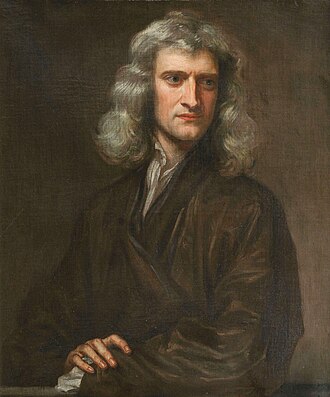
Born in England in 1643, Isaac Newton is regarded as the author of the greatest synthesis of the Scientific Revolution and one of the greatest geniuses in history. During the “miraculous years” of 1665–66, when the plague drove him from Cambridge to the countryside, he laid the foundations of three simultaneous revolutions: the infinitesimal calculus, the theory of colors, and the law of gravitation. A complex man, he also devoted himself, in secret, to alchemy and to heterodox theological studies. He was Master of the Mint and President of the Royal Society, and is buried in Westminster Abbey.
His masterpiece, the Principia Mathematica (1687), achieves an astonishing unification. With three laws of motion (inertia; force equals mass times acceleration; action and reaction) and the law of universal gravitation — according to which all matter attracts all matter — Newton demonstrated that the same force that makes an apple fall governs the orbits of the planets. Heaven and Earth obeyed, for the first time, the same mathematical laws. His three laws explained exactly the motions that Kepler had described.
Newton was also a philosopher of science. His maxim “hypotheses non fingo” (“I feign no hypotheses”) expressed the refusal of unverifiable metaphysical speculation: science must formulate mathematical laws confirmed by experience, without losing itself in the search for hidden causes. This model of reason became the paradigm of the Enlightenment: it influenced the empiricism of Hume, the epistemology of Kant, and the image of a universe governed by exact laws — the classical physics that would reign supreme until Einstein.
Key Concepts
- Law of Gravity: F = G·m₁·m₂/r² — a single principle explains both falling bodies and planets
- 3 Laws of Motion: inertia; F = m·a; action and reaction
- “Hypotheses non fingo”: I do not construct speculative hypotheses — only laws verified by experience
- Optics: decomposition of white light by prism
- Co-inventor of infinitesimal calculus (independently of Leibniz)
- Absolute space as the “sensorium” of God — Newton was deeply religious
Influenced by
- Galileo — mechanics and method
- Kepler — orbital laws
- Descartes — analytic geometry
- Francis Bacon — empirical method
Influenced
- Hume — causality as regularity
- Kant — epistemological Copernican revolution
- All of the Enlightenment — model of scientific reason
- Laplace — complete mechanistic determinism
Works
Philosophiae Naturalis Principia Mathematica (1687); Optics (1704).
See also
Scientific Revolution