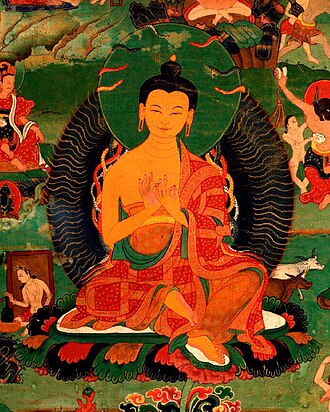
Nāgārjuna (c. 150–c. 250 CE) is the founder of the Mādhyamaka school of Mahāyāna Buddhism and is regarded in many Buddhist traditions as the second Buddha. His work exercised decisive influence on Tibetan, Chinese (and thence Japanese and Korean) Buddhism, as well as on subsequent Indian philosophy. His principal work, the Mūlamadhyamakakārikā (MMK — Fundamental Verses on the Middle Way), is one of the most commented and debated texts in the history of philosophy.
Critical note on dating and authorship: The dates assigned to Nāgārjuna are approximate and based on indirect sources. The attribution to him of several texts (beyond the MMK) is contested in specialist scholarship — there may have been more than one author bearing the name Nāgārjuna.
Key Concepts
Śūnyatā (空 / शून्यता) — Emptiness: The central concept of Mādhyamaka. All phenomena are śūnya (empty) of inherent existence (svabhāva). This does not mean that phenomena do not exist — it means they do not exist by themselves, independently, with a fixed intrinsic nature. Everything exists in dependence on causes, conditions, and conceptual designation.
Pratītyasamutpāda (緣起) — Dependent Origination: The foundational principle of early Buddhism that Nāgārjuna radicalises. Every phenomenon arises dependently — nothing exists in a non-relational mode. Nāgārjuna uses this principle to show that even the concepts of svabhāva (inherent existence), dharmas (constituents of reality), time, and causality are empty of independent existence.
Emptiness of Emptiness: To prevent śūnyatā from being reified into a new absolute (a metaphysical Nothingness), Nāgārjuna asserts that emptiness itself is empty. Emptiness is not an independently real entity — it is a conventional designation useful for pointing to the absence of inherent existence. To assert “everything is empty” is still a conventional statement.
The Two Truths: The doctrine of the Two Truths (dvayasatya):
- Saṁvṛti-satya (conventional / mundane truth): At the ordinary level of experience, distinctions between things, causes and effects, virtue and vice are valid and operational. Convention is not denied.
- Paramārtha-satya (ultimate / supreme truth): At the ultimate level, phenomena are empty of inherent existence. Nirvāṇa and saṁsāra do not ultimately differ — both are empty. Confusion between the two levels is one of the principal sources of philosophical error and suffering.
Catuṣkoṭi (四句) — Tetralemma: A logical schema of four positions: P, not-P, both P and not-P, neither P nor not-P. Nāgārjuna systematically employs the tetralemma to show that none of the four metaphysical positions concerning the nature of phenomena is defensible — a result that points toward silence beyond conceptual categories.
Prasaṅga (Consequential Reasoning / Reductio): Nāgārjuna’s preferred argumentative method. Rather than establishing positive theses, he derives absurd consequences from the opponent’s positions — refutation without asserting an alternative position of his own.
Nirvāṇa and Saṁsāra: In the final chapter of the MMK, Nāgārjuna asserts that there is no essential difference between nirvāṇa (liberation) and saṁsāra (the cycle of rebirths): both are empty. This claim generated long controversy — some read it as a collapse of the practical distinction, others as an indication that liberation is not passage to another realm but a transformation of perspective.
Influenced by
- Early Buddhist teachings (Pāli Canon and Āgamas)
- Prajñāpāramitā texts (Perfection of Wisdom, c. 1st century BCE – 1st century CE)
- Abhidharma tradition — which Nāgārjuna extensively critiques
Influenced
- Āryadeva (c. 2nd–3rd century CE) — principal disciple
- Candrakīrti (c. 7th century CE) — systematisation of Prāsaṅgika Mādhyamaka
- Tsongkhapa (1357–1419) — Tibetan transmission of Mādhyamaka
- Zen/Chan traditions — notion of emptiness and paradox
- Derek Parfit — acknowledged affinities between Mādhyamaka and his thesis on personal identity in Reasons and Persons
Works
Mūlamadhyamakakārikā (MMK, Fundamental Verses on the Middle Way); Vigrahavyāvartanī (The Dispeller of Disputes); Śūnyatāsaptati (Seventy Verses on Emptiness); Ratnāvalī (Precious Garland); Yuktiṣāṣṭikā (Sixty Verses on Reasoning) — the attribution of several texts is debated.
See also
Eastern Philosophy
Recommended books:
 Mūlamadhyamakakārikā — Nāgārjuna (trans. Jay Garfield)
Ver na Amazon →
Mūlamadhyamakakārikā — Nāgārjuna (trans. Jay Garfield)
Ver na Amazon →