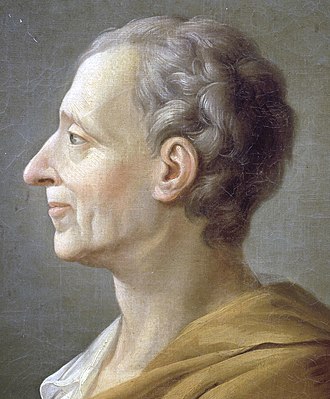
Charles-Louis de Secondat, Baron de Montesquieu, was born in 1689 near Bordeaux, into a family of the nobility of the robe. A magistrate and president of the Parlement of Bordeaux, he won literary fame with the Persian Letters (1721), an anonymous and witty satire that criticizes French customs and institutions through the eyes of fictional Persian travelers. After traveling through Europe — admiring above all the English constitution — he devoted some twenty years to his masterpiece, The Spirit of the Laws (1748), in which he founded the modern comparative science of politics.
His most famous contribution is the theory of the separation of powers. To prevent despotism, the legislative, executive, and judicial powers must be in distinct and independent hands, so that “power checks power.” This idea became one of the pillars of modern constitutionalism: the framers of the United States Constitution (1787) applied it almost directly.
Montesquieu also proposed a typology of governments — the republic (driven by civic virtue), the monarchy (driven by honor), and despotism (driven by fear) — each with its own animating principle. And he was a pioneer of a comparative, sociological method: laws are not universal, abstract precepts but must be understood in relation to the climate, geography, history, and customs of each people. Although his thesis about the influence of climate is contested today, his approach inaugurated the scientific analysis of institutions and influenced figures from Rousseau to contemporary political science.
Key Concepts
- Separation of powers: legislative, executive, and judicial power must be exercised by distinct and independent bodies to prevent despotism — “In order that power should not be abused, it is necessary that, by the arrangement of things, power should check power”
- Three forms of government: republic (civic virtue), monarchy (honor), despotism (fear) — each requires a different motivating principle
- Climatic and geographic determinism: climate, soil, and customs influence the forms of government and laws (contested thesis, but methodologically innovative)
- Comparative analysis: laws must be analyzed in relation to the historical, geographic, and social context of each people — there is no abstract universal model
- Persian Letters (1721): satirical critique of French society through the fictional perspective of Persian travelers
Influenced by
- Locke — division of power and consent
- Hobbes — analysis of the state and political power
- Machiavelli — political realism
- Roman jurists — analysis of laws
Influenced
- U.S. Constitution (1787) — Madison and the Federalists applied it directly
- Rousseau — debate on forms of government
- Modern constitutionalism
- Comparative political science
Works
Persian Letters (1721); Considerations on the Causes of the Grandeur of the Romans and their Decline (1734); The Spirit of the Laws (1748).
See also
Contractualism, Enlightenment and Kant