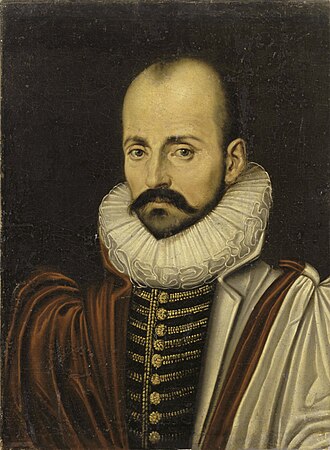
Born in 1533 at his family’s château in the Périgord, Michel de Montaigne received a refined humanist education — raised to speak Latin as his first language. He served as a magistrate in the Parlement of Bordeaux, where he formed a profound friendship with Étienne de La Boétie, whose death would mark him forever. Around 1571 he withdrew to the tower of his château, surrounded by books, and there, amid the bloody Wars of Religion, he began to write a work of an entirely new genre: the Essays. He is one of the fathers of modern thought and the inventor of the essay as a literary and philosophical form.
The essai is neither treatise nor system but an “attempt”: a free, inconclusive exploration in which the author himself is at once object and instrument. “Every man,” Montaigne writes, “bears within himself the entire form of the human condition”; thus, in examining himself with unprecedented honesty — his contradictions, habits, fears — he speaks of all of us. His motto, engraved on a medallion, is a question: “Que sais-je?” (“What do I know?”).
This question condenses his moderate skepticism, heir to ancient Pyrrhonism (Pyrrho): not a paralyzing nihilism, but an intellectual humility that distrusts dogmatic certainties and, for that very reason, liberates. From this attitude spring a cultural relativism remarkable for its time — in the essay “Of Cannibals,” he judges the Europeans who torture to be more barbarous than the peoples of the New World — and a firm critique of cruelty. Inclined toward the moderation of Epicurus and Seneca, Montaigne directly influenced Descartes (whose methodical doubt responds to his), Pascal, and the whole tradition of the essay and of Enlightenment tolerance.
Key Concepts
- The essay as form: not a systematic treatise — it is an attempt (essai), exploration without definitive conclusion; the thinking self is both the object and the instrument of investigation. “Every man bears within himself the entire form of the human condition”
- Moderate skepticism (“Que sais-je?” — What do I know?): doubts philosophical, religious and scientific certainties; ancient Pyrrhonism (Pyrrho) reread as intellectual humility, not as nihilism. Doubt liberates and does not paralyze
- Cultural relativism: he visited “cannibalism” — and concluded that Europeans who torture for pleasure are more barbarous than the Tupinambá; custom is the tyrant of opinions
- Self-knowledge: What do I know? begins in me — the unstable, contradictory, fluid self; against any doctrine of a fixed human essence. “I do not paint being, I paint passage”
- Critique of cruelty: abhorred torture and violence; early defense of compassion as the foundation of morality
- Epicureanism and Stoicism: engages with both; inclines toward Epicurean moderation — living well is living with sensible pleasure, friendship and retreat
Influenced by
- Pyrrho and ancient skepticism — doubt as philosophical stance
- Epicurus and Seneca — art of living, presence in the moment
- Renaissance humanism — Erasmus, Plutarch
- Experience of the Wars of Religion — distrust of ideological certainties
Influenced
- Descartes — methodical doubt (responds to Montaigne’s skepticism)
- Pascal — Pensées dialogues with Montaigne
- Francis Bacon — English essay and empiricism
- Modern skepticism and British empiricism
- Enlightenment — tolerance and cultural relativism
Works
Essays (1580, 1588, posthumous edition 1595) — 3 books, 107 chapters; Travel Journal (posthumous).
See also
Humanism and Renaissance