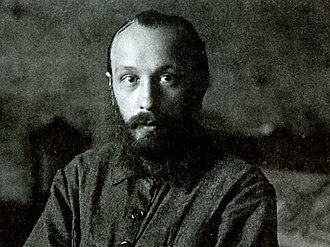
Mikhail Mikhailovich Bakhtin (16 November 1895, Oryol — 7 March 1975, Moscow) was a philosopher of language and a theorist of literature and culture. Marginalized and almost unknown during his lifetime in the Soviet Union — arrested and sent into exile in 1929, he taught for decades at provincial universities — he was rediscovered from the 1960s onward and became one of the most influential Russian thinkers in the world across the humanities. He was the center of the so-called Bakhtin Circle, which also included Valentin Voloshinov and Pavel Medvedev (the authorship of some works signed by them is a matter of scholarly debate).
Key Concepts
- Dialogism: the fundamental principle of his thought. Every utterance is constitutively addressed to another and responds to prior utterances; meaning does not originate in an isolated consciousness but in the interaction among voices. To the “monologic” word, which seeks to close off meaning, he opposes the dialogic word, always open to a reply.
- Polyphony: in Problems of Dostoevsky’s Poetics (1929; revised 1963), Bakhtin describes the Dostoevskian novel as polyphonic — a plurality of autonomous, fully valid voices and consciousnesses that are not subordinated to a single authorial voice. The author does not speak about the characters but with them.
- Heteroglossia (raznorechie): the social stratification of language into a multiplicity of discourses, jargons, and voices in tension. The novel is, par excellence, the genre able to orchestrate this diversity — the thesis of the essay “Discourse in the Novel.”
- Carnivalization and the carnivalesque: in his work on François Rabelais (Rabelais and His World, a dissertation of the 1940s published in 1965), he analyzes popular comic culture, “grotesque realism,” the body, and laughter as forces that temporarily invert hierarchies and open a space of freedom and renewal.
- Chronotope: the inseparable configuration of time and space in narrative forms. Each literary genre organizes its own time-space relation, which Bakhtin uses as a category for the historical analysis of forms.
- The answerable act and the “philosophy of the act”: in Toward a Philosophy of the Act (written in the early 1920s, published posthumously in 1986), Bakhtin elaborates an ethics of the unique, unrepeatable act and of the “non-alibi in being” — the answerability (otvetstvennost) of the concrete, situated subject, who cannot delegate his participation in existence.
- Outsideness and unfinalizability: understanding the other requires a “being outside” (vnenakhodimost); and both the person and meaning remain always open and unfinalized (nezavershennost) — never reducible to a final definition.
Influenced by
- Neo-Kantianism (the Marburg School, Hermann Cohen) — in his early work
- Dostoevsky — object and model of dialogic thought
- The reflection on language and the personalism of his time
Influenced
- Tzvetan Todorov, who introduced him to the West (Mikhaïl Bakhtine: le principe dialogique, 1981)
- Julia Kristeva — the concept of intertextuality, derived from dialogism
- Contemporary literary theory, discourse analysis, and cultural studies
- The semiotics of culture (in dialogue with Yuri Lotman’s Tartu–Moscow School)
Works
Toward a Philosophy of the Act (written c. 1920–24; published 1986); Problems of Dostoevsky’s Poetics (1929; rev. ed. 1963); Rabelais and His World (1965); The Dialogic Imagination (essays, incl. “Discourse in the Novel”); Speech Genres and Other Late Essays.
See also
Vladímir Soloviov, Nikolai Berdiáev