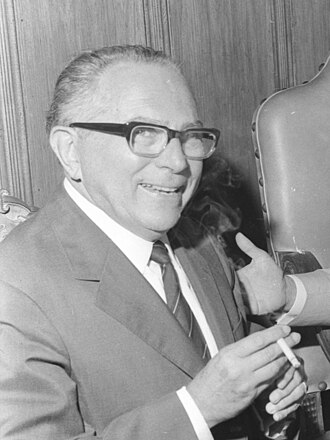
Miguel Reale was born in São Bento do Sapucaí (São Paulo state) on 6 November 1910 and died in São Paulo on 14 April 2006. A law graduate of the Largo de São Francisco Faculty, he was a full professor at the University of São Paulo, of which he was twice rector (1949–1950 and 1969–1973), and held chair 14 of the Brazilian Academy of Letters from 1975 until his death. He is regarded as the most influential Brazilian philosopher of law of the twentieth century and one of the leading representatives of Brazilian culturalism.
Career
Reale began his intellectual career in the 1930s with works such as O Estado Moderno (1934). In November 1932 he joined the Ação Integralista Brasileira, a nationalist political movement led by Plínio Salgado, and rose to national secretary of Doctrine and Studies; he was removed from that post in 1936, for reasons that historiography has not conclusively clarified. This involvement, which biographers record as part of his early formation, is frequently recalled in critical assessments of his political writings.
In the university he established himself as a philosopher of law and an institution-builder: he helped found the Brazilian Institute of Philosophy (1949) and the Revista Brasileira de Filosofia, in which Vicente Ferreira da Silva, for example, collaborated from the institute’s founding. His most publicly visible role came as supervisor of the commission that drafted the Civil Code project, enacted as Law no. 10.406 of 10 January 2002 and in force since 11 January 2003. The project’s long passage through the legislature, begun under the previous regime, drew criticism about its currency, but the new code incorporated the guidelines Reale defended: ethicality, sociality, and operability.
Key Concepts
- Three-dimensional theory of law — juridical experience comprises three inseparable dimensions, fact (sociological), value (axiological), and norm (normative), in a relation of dialectical implication rather than mere juxtaposition. It is set against both formalist normativism and sociologism and abstract natural-law theory. Formulated from the 1940s, it received mature exposition in Teoria Tridimensional do Direito (1968).
- Culturalism — law, morality, and art are products of culture, that is, of the world of values historically realized by human beings, distinct from the natural world. The neo-Kantian tradition underlies this conception, reworked in a historicist key.
- Juridical experience — a concept developed in O Direito como Experiência (1968): law is not abstract pure ought but concrete historical experience, lived by persons and groups.
- Axiological historicism and ontognoseology — terms by which Reale designates, respectively, his view of values as invariants that reveal themselves across history and his theory of the correlation between knowing subject and known object.
Influenced by
- Neo-Kantianism and the philosophy of values, with which he engages in formulating culturalism (commentators often point to his dialogue with Max Scheler and Nicolai Hartmann)
- Husserl’s phenomenology
- José Ortega y Gasset, whose concept of circumstance is often associated with Reale’s view of historical experience
- The Brazilian tradition of the Recife School, especially Tobias Barreto, with whom he shares the conception of law as a cultural phenomenon
Influenced
- Generations of Brazilian jurists and philosophers of law, who adopted or debated tridimensionalism
- Civil-law doctrine after 2002, with the principles of ethicality, sociality, and operability
- The debate on the institutionalization of philosophy in Brazil, through the Brazilian Institute of Philosophy
Works
O Estado Moderno (1934); Teoria do Direito e do Estado (1940); Filosofia do Direito (1953); Teoria Tridimensional do Direito (1968); O Direito como Experiência (1968); Lições Preliminares de Direito (1973).
See also
Tobias Barreto, Hans Kelsen, Max Scheler, José Ortega y Gasset, Vicente Ferreira da Silva, Henrique de Lima Vaz