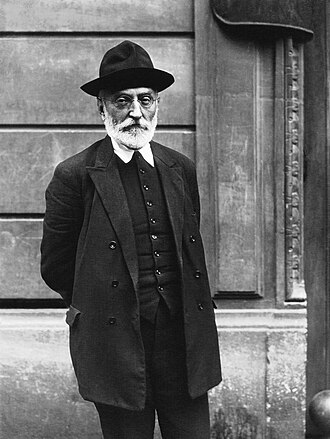
Miguel de Unamuno y Jugo was born in Bilbao on 29 September 1864 and died in Salamanca on 31 December 1936. Professor of Greek language and literature at the University of Salamanca, he served as its rector from 1900 to 1914 and again from 1931, under the Second Republic. A central figure of the Generation of 98, he wrote essays, poetry, drama and novels, and rejected a rigid separation between philosophy and literature. For his opposition to the dictatorship of Primo de Rivera he was exiled to Fuerteventura in 1924 and later lived in Paris and Hendaye until 1930.
His thought rejects system-building and starts from the “man of flesh and bone” (hombre de carne y hueso), not from the abstract subject. In Del sentimiento trágico de la vida en los hombres y en los pueblos (1912), his best-known philosophical work, he describes an unresolvable conflict between reason, which cannot demonstrate personal immortality, and the vital longing not to die, the “hunger for immortality.” From this contradiction arise life as agony (struggle) and faith as a wager sustained in uncertainty rather than as rational certainty. Unamuno engages with Kierkegaard (whom he read in the original Danish), with Pascal, and with Spinoza, the latter as a counterpoint to his own search for individual persistence (conatus).
In En torno al casticismo (1895) he formulated the notion of intrahistory (intrahistoria): the silent, everyday life of peoples, distinct from the events that historiography records. In Vida de Don Quijote y Sancho (1905) he proposed a reading of Cervantes’s character as a figure of faith and of quixotic heroism. In fiction he created the “nivola,” the term he applied to Niebla (1914), and wrote Abel Sánchez (1917) and San Manuel Bueno, mártir (1931), which dramatize religious doubt.
The episode of 12 October 1936. At the Día de la Raza ceremony in the paraninfo of the University of Salamanca, with the Civil War already under way, Unamuno, who presided over the event, intervened after speeches attacking Catalans and Basques and clashed with General José Millán-Astray. The popularized version, with the phrase “venceréis pero no convenceréis” (“you will win but you will not convince”), goes back to an account by Luis Portillo published in 1941 in the magazine Horizon. Recent historiography, notably the work of Severiano Delgado (University of Salamanca), holds that this wording is a later literary reconstruction and that Unamuno’s exact words cannot be recovered with certainty. What is documented is that the university senate withdrew its confidence in him as rector on 14 October and that the post was declared vacant by decrees of Franco; Unamuno died weeks later, on 31 December 1936.
Key Concepts
- Tragic sense of life — the conflict between reason and the longing for immortality, the core of Del sentimiento trágico de la vida (1912).
- Man of flesh and bone — the concrete individual who is born, suffers and dies, the starting point of philosophy.
- Hunger for immortality — the desire to persist as an individual person, which reason does not satisfy.
- Agony — life and faith as struggle; the title of La agonía del cristianismo (1925).
- Intrahistory — the everyday, anonymous life of peoples, substratum of tradition (En torno al casticismo, 1895).
- Nivola — Unamuno’s own novelistic genre, centred on conflicts of ideas and characters.
Influenced by
- Kierkegaard — individual existence and faith as paradox
- Pascal — the tension between reason and the heart
- Augustine — the restlessness of the heart
- William James — the will to believe and religious pragmatism
- Schopenhauer and Nietzsche — as interlocutors in the critique of reason
Influenced
- José Ortega y Gasset — interlocutor and, on many points, antagonist within the same intellectual generation
- María Zambrano — who read and discussed him in her reflection on philosophy and poetry
- The reception of existentialism in twentieth-century Spanish-language philosophy and literature
Works
En torno al casticismo (1895); Vida de Don Quijote y Sancho (Life of Don Quixote and Sancho, 1905); Del sentimiento trágico de la vida en los hombres y en los pueblos (The Tragic Sense of Life in Men and Nations, 1912); Niebla (Mist, 1914); Abel Sánchez (1917); La agonía del cristianismo (The Agony of Christianity, 1925); Cómo se hace una novela (How to Make a Novel, 1927); San Manuel Bueno, mártir (1931).