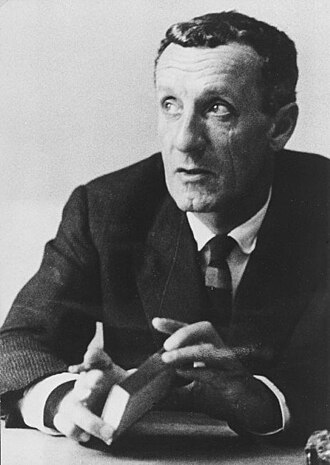
Born in 1908 in France, Maurice Merleau-Ponty trained at the École Normale Supérieure alongside Sartre and Simone de Beauvoir, with whom he would found the review Les Temps Modernes before a political break. In 1952 he became the youngest holder of the chair of philosophy at the Collège de France. He died suddenly in 1961, leaving his last work unfinished. He is the great phenomenologist of the body.
His originality lies in shifting the center of phenomenology. Where Husserl and the early Sartre located subjectivity in consciousness, Merleau-Ponty locates it in the lived body (corps propre). The body is not an object that the mind inhabits, nor a machine moved by the soul: I am my body. It is through the body, and not through a disembodied consciousness, that I have a world — whence the primacy of perception, prior to all reflection and to every separation between subject and object.
From this follows a radical critique of the Cartesian dualism of Descartes: the split between mind and body is an abstraction, for lived experience is always incarnate. Merleau-Ponty’s favorite example is that of the hand that touches the other hand and, in the same gesture, is touched by it — an irreducible ambiguity between sensing and being sensed. In his late work he generalizes this in the concept of flesh (chair): a common fabric of which body and world are made. His influence reaches the philosophy of the body, aesthetics, gender studies (Judith Butler), and the cognitive science of embodied cognition.
Key Concepts
- Lived body (corps propre): the body is not an object among objects — it is the vehicle of being-in-the-world; I am my body, I do not have a body. The body is subject before it is object
- Primacy of perception: perception is not an act of consciousness that interprets sensory data — it is the originary mode of access to the world; prior to the subject/object distinction
- Body schema: the body has a pre-reflective intentional orientation; the example of the hand that touches and is touched — irreducible ambiguity between subject and object
- Flesh (chair, in The Visible and the Invisible): flesh is neither matter nor spirit — it is the common element that makes the world and the body share the same texture; chiasm between the touching and the touched
- Critique of Cartesian dualism: Descartes radically separated mind and body; Merleau-Ponty shows that this separation is abstract — lived experience is always incarnate
- Philosophy of language: speech is not translation of already-formed thoughts — thought forms in speech; linguistic gesture as an extension of bodily gesture
Influenced by
- Husserl — phenomenology (especially Ideas II and the Lebenswelt)
- Heidegger — being-in-the-world and transcendence of pure consciousness
- Gestalt — psychology of perception as figure/ground
- Sartre — existentialism (but diverges on the role of the body)
Influenced
- Philosophy of body and corporality
- Dance, performance arts and aesthetic theory of performance
- Embodied cognitive science (embodied cognition)
- Derrida — chiasm and reversibility
- Judith Butler — corporality and gender
Works
The Structure of Behavior (1942); Phenomenology of Perception (1945); The Visible and the Invisible (posthumous, 1968); Eye and Mind (1961).
See also
Twentieth-Century Philosophy