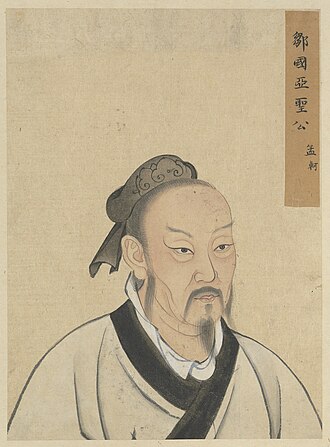
Note on sources: The dates of Mencius (孟子 Mèngzǐ, “Master Meng”; personal name Kē 軻) are conventional estimates — c. 372–289 BCE — based on traditional historical chronologies. The text Mèngzǐ (孟子), compiled in 7 books (piān), is considered more unified than Confucius’s Analects, although it also involved contributions from disciples in its final redaction. Mencius is honored in the Confucian tradition as the “Second Sage” (Yàshèng 亞聖), immediately below Confucius.
Mencius studied with disciples of Zisi (子思), grandson of Confucius, thus transmitting the direct lineage of the teaching. He lived in the same period of political fragmentation known as the Warring States and, like Confucius, traveled among various states advising rulers on virtuous governance. His greatest contribution was to systematize and deepen the psychological foundation of Confucian ethics.
Key Concepts
Innate goodness of human nature (xìng shàn 性善): Against Gaozi’s (告子) neutral position — who compared human nature to water with no prior inclination in any direction — Mencius argues that human nature is originally good. Not that human beings are saints, but that they possess innate moral inclinations which, if cultivated, lead to virtue. Book VI of the Mèngzǐ contains the central debate with Gaozi on this point.
Four Moral Sprouts (sìduān 四端): Mencius identifies four innate dispositions that are the “germs” or “sprouts” of the four cardinal virtues: (1) the feeling of commiseration/compassion (cèyǐn zhī xīn 惻隱之心) is the sprout of benevolence (rén 仁); (2) the feeling of shame and aversion to wrongdoing (xiūwù zhī xīn 羞惡之心) is the sprout of righteousness (yì 義); (3) the feeling of deference and modesty (círàng zhī xīn 辭讓之心) is the sprout of ritual propriety (lǐ 禮); (4) the feeling of approval and disapproval (shìfēi zhī xīn 是非之心) is the sprout of wisdom (zhì 智). Those who lack these four feelings are not truly human.
Heavenly Mandate and the legitimacy of rulers (tiānmìng 天命): Mencius develops the doctrine of the Mandate of Heaven to ground both the legitimacy of rulers and the right to depose them. The ruler who abandons benevolence loses the mandate — the people are the most important element, the altars of grain and soil come next, and the sovereign is the least important. A tyrant may be overthrown because he ceases to be a legitimate sovereign and becomes merely a common man who violates the natural order.
King (wáng 王) versus Hegemon (bà 霸): Mencius distinguishes two models of political leadership. The true king governs through virtue (dé 德) and love of the people — the people follow him voluntarily because they trust him. The hegemon governs through force and realpolitik — he obtains outward compliance but not inner allegiance. The royal model is superior and more enduring.
Moral cultivation (gōngfu / cúnyǎng 存養): Innate goodness does not develop automatically — it requires constant cultivation. The famous metaphor of farming: the man who pulls up his seedlings to make them grow faster kills them; moral cultivation requires patience, attention, and sustained practice. “Apply yourself to it, but do not force it” (bì yǒu shì yān, wù zhèngxīn 必有事焉,勿正心).
The well-field agrarian system (jǐngtián 井田): Mencius advocates a land distribution system in which each block of land is divided into 9 parts (like the character 井, “well”): eight families cultivate their private plots and together cultivate the central plot, whose yield goes to the state. This economic proposal is linked to his political ethics: the ruler must ensure that the people have means of subsistence so that they can develop their moral character.
The heart-mind (xīn 心): For Mencius, xīn (heart-mind) is the organ of moral thought. The fundamental task of moral philosophy is to recover the “lost heart” — the original goodness obscured by adverse habits, circumstances, and uncultivated desires.
Influenced by
- Confucius — ethics of virtues, ideal of the jūnzǐ, the central role of benevolence (rén)
- Zisi (子思, grandson of Confucius) — direct transmission of the Confucian lineage
- Tradition of the Zhou Classics — Shijing, Shujing as normative authorities
Influenced
- Xunzi (c. 310–c. 235 BCE) — opposing position: human nature as deficient (need for external cultivation)
- Neo-Confucianism (Zhu Xi, 12th century; Wang Yangming, 15th–16th century) — Mencius becomes one of the canonical “Four Books” (Sìshū)
- Wang Yangming (1472–1529) — emphasis on innate moral consciousness (liángzhī 良知) deepens Mencius’s insight
- Contemporary virtue ethics — frequent comparisons between the “moral sprouts” and moral emotions in Western moral psychology (Philippa Foot, Jonathan Haidt)
- Contemporary Confucian political philosophy — debates on rights of resistance and democratic legitimacy
Works
Mèngzǐ (孟子) — 7 books (piān), subdivided into parts A and B (totaling 14 chapters in traditional numbering): Liánghùiwáng (梁惠王), Gōngsūnchǒu (公孫丑), Téngwéngōng (滕文公), Lígòu (離婁), Wànzhāng (萬章), Gàozǐ (告子), Jǐnxīn (盡心). Canonized as one of the “Four Books” (Sìshū 四書) by Zhu Xi in the 12th century.
See also
Eastern Philosophy; Confucius; Xunzi
Recommended Books:
 Mencius (trans. D.C. Lau, Penguin Classics)
Ver na Amazon →
Mencius (trans. D.C. Lau, Penguin Classics)
Ver na Amazon →