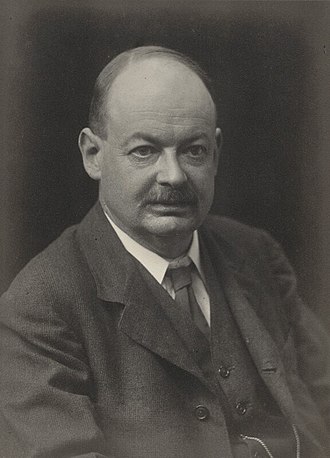
John McTaggart Ellis McTaggart was born in London on 3 September 1866 and spent virtually his entire career as a fellow and lecturer in philosophy at Trinity College, Cambridge; he retired in 1923 and died in London on 18 January 1925. Shaped by the British Idealism of the late nineteenth century — alongside Francis Herbert Bradley and decisively influenced by Hegel — McTaggart developed a systematic and strikingly original metaphysics that sets itself apart from Bradley’s absolute monism on one side and the emergent naturalism that would come to dominate twentieth-century philosophy on the other. His magnum opus, The Nature of Existence (2 vols., 1921–1927), stands as one of the last grand metaphysical systems in the English-speaking philosophical tradition, built with a logical rigour that bears comparison to Hegel’s Science of Logic. In the philosophy of time, his distinction between the A-series and the B-series — published in the article “The Unreality of Time” (Mind, 1908) — became the obligatory starting point for every subsequent debate on the ontology of time.
McTaggart’s central project is double-edged: on the one hand, to demonstrate that time as ordinarily conceived is internally contradictory and therefore unreal; on the other, to show that ultimate reality consists in an infinite community of spiritual substances — selves or souls — bound together by relations of love and mutual perception. This personal idealism sets him apart from both pantheism and traditional theism: McTaggart was an avowed atheist (he rejected the existence of an absolute creator God), yet he maintained that souls are immortal and that the structure of reality is essentially good. In Some Dogmas of Religion (1906), he argued that religion consists in a harmony with the universe that does not depend on belief in a personal God.
Key Concepts
A-series and B-series (“The Unreality of Time,” Mind, 1908): the A-series orders events according to the determinations of past, present, and future — determinations that change continuously and are, McTaggart argues, indispensable for genuine change. The B-series orders events by the permanent relations of earlier and later. McTaggart contends that the A-series is necessary for real time to exist, yet it is internally contradictory: every event must be simultaneously past, present, and future, and any attempt to resolve the contradiction appeals to a higher-order A-series, generating a vicious infinite regress. Conclusion: time is unreal.
C-series: the real ordering underlying temporal appearances. The C-series is a permanent ordering of terms (analogous to the B-series in its immutability) but without any intrinsic temporal direction. The appearances of past, present, and future are subjective projections onto this atemporal structure. The A/B/C vocabulary introduced here remains canonical in the metaphysics of time.
Personal idealism and the community of selves: in The Nature of Existence, McTaggart argues that all reality is composed of immaterial substances (persons or selves), infinitely divisible into parts that are themselves selves. These substances perceive one another and are united by love. There is no matter, no real physical space, no transcendent God — only an eternal network of minds contemplating one another in mutual perception.
Immortality of the soul without theism: McTaggart defended personal immortality — and even the pre-existence of the soul — on the basis of the metaphysical structure his system described, without any appeal to revelation or to the existence of a creator. His is a rare case of a philosophical defense of immortality entirely detached from revealed religion.
Hegelian dialectic and its reconstruction: in Studies in the Hegelian Dialectic (1896) and A Commentary on Hegel’s Logic (1910), McTaggart set out to reconstruct Hegel’s dialectical method on more rigorous logical foundations. Although he did not accept the Hegelian system wholesale — especially its absolute monism — he extracted from Hegel the conviction that reason can reach metaphysical truths about the ultimate structure of reality.
Influenced by
- Hegel — primary source of the dialectical method and absolute idealism, critically revised
- Francis Herbert Bradley — British Idealism, monism, and the critique of relations
- The Platonic tradition of the soul’s immortality, reworked without theological underpinning
Influenced
- Bertrand Russell — student at Cambridge; the young Russell passed through an idealist phase partly under McTaggart’s influence before breaking with idealism
- G. E. Moore — also a student at Cambridge; his realist revolt was in part a reaction against McTaggartian idealism
- C. D. Broad — student and posthumous editor of vol. II of The Nature of Existence; devoted extensive analyses to McTaggart’s philosophy of time
- The entire contemporary debate in the metaphysics of time: the A-series/B-series distinction structures the positions now known as the A-theory and B-theory of time
- Bergson — parallel engagement with the problem of time, though with opposing conclusions
Works
Studies in the Hegelian Dialectic (1896; 2nd ed. 1922); Studies in Hegelian Cosmology (1901; 2nd ed. 1918); Some Dogmas of Religion (1906); “The Unreality of Time” (Mind, 1908); A Commentary on Hegel’s Logic (1910); The Nature of Existence, vol. I (1921), vol. II (posthumous, 1927, ed. C. D. Broad); Philosophical Studies (1934, posthumous).
See also
Hegel Russell Bergson C. D. Broad G. E. Moore