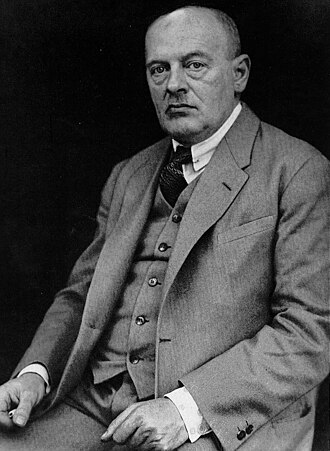
Max Scheler was born in Munich on 22 August 1874 and died in Frankfurt on 19 May 1928. He studied in Munich, Berlin and Jena, where he took his doctorate under Rudolf Eucken. He met Edmund Husserl in 1901 and became one of the figures of the phenomenological movement, active in Munich and in the Göttingen circle. A convert to Catholicism, he was a professor at Cologne from 1919, where he was meant to be the Catholic thinker of the new social-science research institute, and in 1927 took up a chair at Frankfurt. His work is among the most influential in German philosophy of the first half of the twentieth century, though it remained unfinished.
Phases of His Thought
Commentators usually distinguish three periods, whose dating varies. In the early phase, at Jena, Scheler engages with neo-Kantianism and with Eucken’s philosophy of life. In the phenomenological and Catholic phase (roughly 1912–1921), he publishes his best-known works on ethics, feeling and religion, among them Der Formalismus in der Ethik und die materiale Wertethik (1913–1916) and Vom Ewigen im Menschen (1921). In the late phase, from the 1920s, he moves away from the Church and from traditional Christian theism; in it God is conceived as a becoming realized through spiritual beings, and Scheler develops a sociology of knowledge and a philosophical anthropology, set out in Die Wissensformen und die Gesellschaft (1926) and Die Stellung des Menschen im Kosmos (1928).
Key Concepts
- Material ethics of values — against the ethical formalism of Kant, he holds that ethics rests on material values given a priori in an emotional intuition (the “feeling of value”), not on mere forms of duty.
- Hierarchy of values — an objective, non-relative ordering of values, from the agreeable and the useful through vital and spiritual values to the holy at the summit; the hierarchy is grasped intuitively and does not depend on epochs or cultures.
- Person — the concrete unity of acts, never reducible to any single act or to an object; it is grasped through love and the understanding of value, and is the sole subject of ethical responsibility.
- Sympathy and love — in Wesen und Formen der Sympathie (1913; reworked in 1923), he analyzes emotional contagion, sympathy and love, criticizing theories that explain knowledge of other people by analogy or projection.
- Ressentiment — his analysis of ressentiment as the source of certain moral formations, drawing on Nietzsche, in the essay on ressentiment in the structure of moralities (1912; reworked in 1915).
- Philosophical anthropology — in Die Stellung des Menschen im Kosmos (1928), the human being arises from the meeting of vital drive (Drang) and spirit (Geist); spirit is objectifying and open to the world but, according to Scheler, dependent on the energy of the drive for its realization.
Influenced by
- Edmund Husserl, from whom he received the phenomenological impulse, though he applied the method to value contents that Husserl did not thematize in the same way
- Rudolf Eucken, his supervisor, and Friedrich Nietzsche, on themes such as life and ressentiment
- Blaise Pascal and Saint Augustine, whose ideas on the “order of the heart” and the order of love he takes up
- Immanuel Kant and Henri Bergson, as critical interlocutors
Influenced
- Edith Stein, whose analysis of empathy is in dialogue with Scheler’s
- Nicolai Hartmann and Dietrich von Hildebrand, in the ethics of values
- German philosophical anthropology, with Helmuth Plessner and Arnold Gehlen
- Martin Heidegger, who dedicated to Scheler’s memory, after his death, the book Kant and the Problem of Metaphysics (1929)
- Karol Wojtyła, who critically examined Scheler’s ethics in his habilitation thesis (1950s), before becoming John Paul II
Works
Der Formalismus in der Ethik und die materiale Wertethik (1913–1916); Wesen und Formen der Sympathie (1913); Der Genius des Krieges und der Deutsche Krieg (1915); Vom Ewigen im Menschen (1921); Die Wissensformen und die Gesellschaft (1926); Die Stellung des Menschen im Kosmos (1928).
See also
Edmund Husserl, Edith Stein, Martin Heidegger, Romano Guardini, Nietzsche