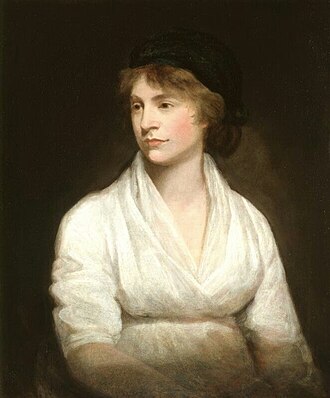
Mary Wollstonecraft was a British writer, philosopher, and advocate for women’s rights, whose A Vindication of the Rights of Woman (1792) is considered one of the founding texts of modern philosophical feminism. A contemporary of the American and French revolutions, Wollstonecraft applied Enlightenment principles of reason and equality to relations between the sexes, challenging the division between public and private spheres that excluded women from full citizenship.
Key Concepts
Rational Equality (A Vindication of the Rights of Woman, 1792): Her central argument — women and men share the same rational nature. If reason is the foundation of dignity and rights, as the Enlightenment thinkers hold, then women have the same entitlement to political and educational rights as men. The exclusion of women from the rational sphere is inconsistent with the very principles of the Enlightenment.
Critique of Women’s Education: The conventional education of women cultivated ornament, passivity, and seductiveness rather than reason and virtue. Wollstonecraft argues that this education does not educate — it corrupts. Women trained to please are reduced to a permanent infantilism, becoming incapable of exercising moral and civic responsibilities.
Critique of Rousseau: Émile (1762) prescribes for Sophie — the ideal woman — an education radically different from Émile’s, oriented toward submission and pleasing men. Wollstonecraft sees in this an internal contradiction: Rousseau condemns political despotism while prescribing domestic despotism. A woman educated in dependence will be a bad wife, a bad mother, and a bad citizen.
Virtue and Morality: Wollstonecraft upholds an ethics of Kantian orientation avant la lettre: virtue is the same for men and women — it involves the exercise of reason, moral autonomy, and the fulfilment of duties. Virtue is neither feminine nor masculine, but human. The “femininity” cultivated by contemporary education is incompatible with genuine virtue.
Citizenship and Public Life: Women should not be confined to the home — they should participate in public life as citizens. Wollstonecraft calls for women’s access to education, to the professions, and implicitly to the vote (a question she does not develop systematically, but which her premises imply).
A Vindication of the Rights of Men (1790): The first published response to Edmund Burke’s Reflections on the Revolution in France, written before the Vindication of the Rights of Woman. Wollstonecraft defends the principles of the French Revolution and attacks Burke’s conservatism.
Influenced by
- Locke — natural rights theory
- Rousseau — appropriated and critiqued; the egalitarianism of the Discourse on Inequality is turned against Émile
- Richard Price (1723–1791) — Radical Presbyterianism and defence of the French Revolution
- Scottish Enlightenment (Burgh, Fordyce) — critically
Influenced
- 19th-century feminism: Elizabeth Cady Stanton, Harriet Taylor Mill
- Simone de Beauvoir — argument for the social construction of femininity
- Liberal political philosophy and contemporary liberal feminism
- John Stuart Mill, The Subjection of Women (1869)
Works
Thoughts on the Education of Daughters (1787); Mary: A Fiction (1788); A Vindication of the Rights of Men (1790); A Vindication of the Rights of Woman (1792); An Historical and Moral View of the French Revolution (1794); Letters Written During a Short Residence in Sweden, Norway, and Denmark (1796); Maria: or, The Wrongs of Woman (1798, posthumous).
See also
Contractualism and Enlightenment Nineteenth-Century Philosophy
Recommended books:
 A Vindication of the Rights of Woman — Mary Wollstonecraft
Ver na Amazon →
A Vindication of the Rights of Woman — Mary Wollstonecraft
Ver na Amazon →