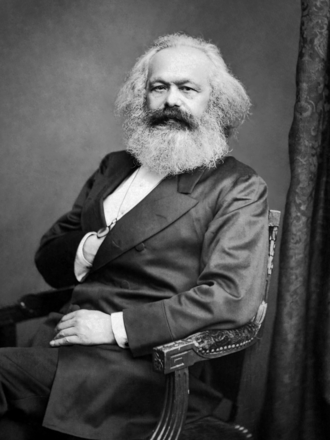
Born in Trier, in the Prussian Rhineland, in 1818, Karl Marx studied law and philosophy in Bonn and Berlin, where he drew close to the Young Hegelians. Barred from an academic career by his radical positions, he turned to journalism and, hounded by censorship, went into exile in Paris, Brussels, and finally London, where he lived through decades of poverty, sustained by his friend and collaborator Friedrich Engels and poring over the economists in the Reading Room of the British Museum. More than to interpret the world, he wanted to transform it: “the philosophers have only interpreted the world in various ways; the point, however, is to change it” (Thesis 11 on Feuerbach).
Philosophically, Marx sets out from Hegel but “stands him on his feet”: dialectics moves not ideas but the material conditions of life. This is historical materialism — the thesis that the economic base (the forces and relations of production) conditions the superstructure (State, law, religion, ideology). Hence his famous formula that “all history is the history of class struggle.” Following Feuerbach in the critique of religion — the “opium of the people” — Marx sees in the dominant ideas not eternal truths but the reflection of the interests of the ruling class.
The heart of his mature work is the critique of political economy, set out in Capital (1867). Under capitalism, the worker sells his labor power and produces more value than he receives in wages: this appropriated surplus is surplus value, the source of profit and of exploitation. The result is alienation — the worker becomes a stranger to his own product, to his labor, and to himself — and commodity fetishism, in which relations between people appear as relations between things. The overcoming of this system would be communism, a classless society. Marx’s influence on the politics, economics, and social sciences of the twentieth century is incalculable — even though his thought is not to be conflated with the regimes that invoked his name.
Key Concepts
- Historical materialism: the economic infrastructure (forces + relations of production) determines the superstructure (State, law, ideology)
- Class struggle: all history is the history of class struggles — free/slave, lord/serf, bourgeois/proletarian
- Alienation: the worker is alienated from his product (it belongs to the capitalist), from the process, from others, and from his human essence
- Surplus value (Mehrwert): the capitalist appropriates the unpaid excess labor of the worker
- Commodity fetishism: relations between people appear as relations between things
- Communism: classless society, without State, without alienation — the final stage after the proletarian revolution
- Praxis: unity of theory and transformative practice
Influenced by
- Hegel — dialectics (inverted)
- Feuerbach — materialism and critique of religion
- Classical political economy (Smith, Ricardo)
Influenced
- Engels (collaborator and successor)
- Lenin, Gramsci, Mao — political Marxism
- Frankfurt School — Adorno, Horkheimer, Marcuse
- Sartre — existentialist Marxism
- All critical social theory of the 20th century
Works
Economic and Philosophic Manuscripts (1844); The German Ideology (1845–46, with Engels); The Communist Manifesto (1848, with Engels); Capital, vol. 1 (1867).
See also
Nineteenth-Century Philosophy