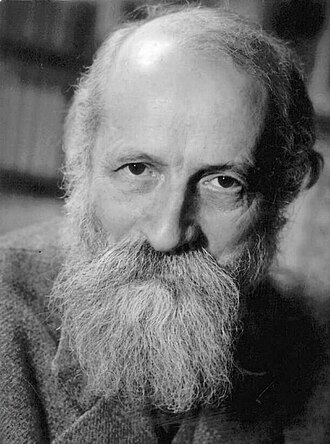
Martin Buber was born in Vienna on 8 February 1878 and died in Jerusalem on 13 June 1965. Raised in Lemberg (Lviv) in the home of his grandfather, the scholar Salomon Buber, he studied philosophy, art history, and German studies in Vienna, Leipzig, Berlin, and Zurich. He became involved early with cultural Zionism and devoted himself to the study of Hasidism, the mystical Jewish tradition of Eastern Europe, which he popularized in works such as The Tales of Rabbi Nachman (1906) and The Legend of the Baal-Shem (1908). From 1925 until the work’s completion in 1961 he translated the Hebrew Bible into German, in collaboration with Franz Rosenzweig and then alone after the latter’s death in 1929. He taught at Frankfurt (1924–1933); with the rise of Nazism he emigrated to Palestine in 1938, where he taught social philosophy at the Hebrew University of Jerusalem.
His most influential work is Ich und Du (1923; I and Thou), an aphoristic text proposing an ontology of relation. Buber distinguishes two “primary words”: I-Thou, in which the other is encountered as a total presence, in reciprocity and without the mediation of aims, and I-It, in which the other is treated as an object of experience and use. Both attitudes are necessary to human life, but genuine encounter occurs only in the former, and for Buber the “eternal Thou,” God, is the Thou that never becomes It. The space of relation is described as “the between” (das Zwischen), which belongs neither to the subject nor to the object alone. In later works, such as Between Man and Man (1947), Das Problem des Menschen (1948), and Eclipse of God (1952), he developed this perspective in philosophical anthropology, pedagogy, and philosophy of religion. In 1957 he held a celebrated public dialogue with the psychologist Carl Rogers.
Key Concepts
- I-Thou and I-It — the two fundamental attitudes of the human being toward the world and others.
- The between (das Zwischen) — the sphere of the dialogical relation, where meaning occurs.
- Dialogue — genuine encounter between persons, requiring presence, reciprocity, and openness.
- The eternal Thou — God as the absolute interlocutor, conceived in relation rather than as an object of knowledge.
- Hasidism — a spirituality that seeks the sacred in everyday life, reinterpreted by Buber as a model of dialogical life.
- Eclipse of God — an expression for the loss of relation to the divine in modern culture.
- Utopia and community — in Paths in Utopia (first published in Hebrew, 1947; English edition 1949; German Pfade in Utopia, 1950), a defense of a communitarian, decentralized socialism.
Influenced by
- Hasidism and the Jewish tradition
- Søren Kierkegaard — the notion of the individual before God
- Friedrich Nietzsche — a marked influence in his youth
- Ludwig Feuerbach — the idea of the I and Thou as the foundation of the human
- Wilhelm Dilthey and Georg Simmel, with whom he had contact during his student years
Influenced
- Emmanuel Levinas — who engaged critically with Buber’s philosophy
- Franz Rosenzweig — an interlocutor and collaborator on the Bible translation
- Humanistic psychology and dialogically oriented psychotherapy, as with Carl Rogers
- Dialogical pedagogy and the theology of interreligious dialogue
Works
Daniel (1913); Ich und Du (1923); Zwiesprache (1932); Between Man and Man (1947); Das Problem des Menschen (1948); Paths in Utopia (Hebrew 1947; English 1949; German Pfade in Utopia, 1950); Eclipse of God (1952; German Gottesfinsternis, 1953).
See also
Emmanuel Levinas, Søren Kierkegaard, Gabriel Marcel, Jewish Philosophy, Philosophy of Dialogue