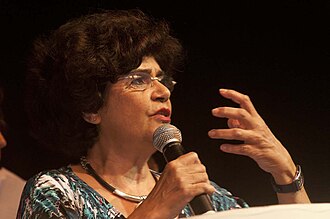
Marilena de Souza Chaui (born 1941 in São Paulo) is one of Brazil’s most influential living philosophers and professor emerita at the University of São Paulo, where she trained and spent her entire teaching career. Her work brings together a deep command of Spinoza’s philosophy and Merleau-Ponty’s phenomenology with a critical, politically engaged reflection on Brazilian society. A staunch defender of the public university and a leftist intellectual, Chaui has also become a major public figure without ever relinquishing academic rigour. Her textbook Convite à Filosofia (1994) is among the most widely read introductions to philosophy in Brazil, and her reading of Spinoza, consolidated in A Nervura do Real, is an internationally recognised contribution to scholarship on the Dutch philosopher.
Key Concepts
- Ideology of competence: Chaui’s critique of the discourse that naturalises inequality by treating only the holders of authorised technical-scientific knowledge as “competent,” thereby silencing other social voices and depoliticising public debate.
- Immanence and freedom in Spinoza (A Nervura do Real, vol. I, 1999; vol. II, 2016): the reading according to which Spinoza’s thought is a philosophy of radical immanence, in which freedom is not opposed to necessity but consists in the adequate knowledge of the causes that determine us.
- Founding myth of Brazil (Brasil: Mito Fundador e Sociedade Autoritária, 2000): the thesis that Brazilian society represents itself through a myth of origin—a blessed, peaceful country without conflict—that conceals and perpetuates authoritarian and violent relations.
- Authoritarian society: the analysis of how authoritarianism in Brazil is not confined to the State but structures everyday social relations themselves, marked by hierarchy, command and inequality.
- Defence of the public university: a reflection on the university as a social institution committed to the production of knowledge and to critical formation, against the conception of the university as a mere provider of services.
- Democracy as a social form: the understanding of democracy not only as a political regime but as the continuous creation of rights and as an openness to legitimate conflict among interests.
Influenced by
- Spinoza — immanence, freedom and the critique of superstition
- Maurice Merleau-Ponty — phenomenology of perception and of the lived world
- Karl Marx — critique of ideology and analysis of social relations
- Claude Lefort — reflection on democracy and power
Influenced
- Brazilian scholarship on Spinoza and the reception of phenomenology
- Brazilian public debate on democracy, authoritarianism and the university
- Generations of students trained through the textbook Convite à Filosofia
- The political reflection of the Brazilian intellectual left
Works
Her output includes her doctoral dissertation on Spinoza, the widely circulated textbook Convite à Filosofia (1994), the study Brasil: Mito Fundador e Sociedade Autoritária (2000), and the two volumes of A Nervura do Real: Imanência e Liberdade em Espinosa (vol. I, 1999; vol. II, 2016), alongside numerous essays on ideology, culture and politics.
See also
Spinoza Maurice Merleau-Ponty Paulo Freire