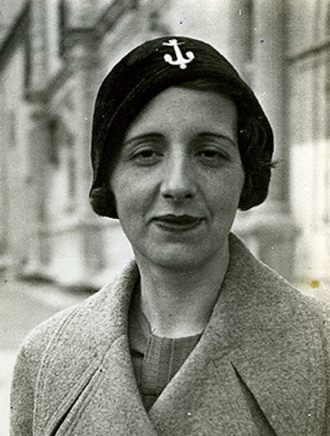
María Zambrano Alarcón was born in Vélez-Málaga on 22 April 1904 and died in Madrid on 6 February 1991. She studied philosophy at the Universidad Central in Madrid, where she was a disciple of José Ortega y Gasset, Xavier Zubiri and Manuel García Morente, and taught before the Civil War. Committed to the Republican cause, she left Spain in 1939 and lived almost half a century in exile, in places including Mexico, Cuba, Puerto Rico, Rome, France and Switzerland, returning to Madrid in 1984. She received the Prince of Asturias Award for Communication and Humanities in 1981 and the Cervantes Prize in 1988, the first woman to win it.
Her work seeks a way of thinking that renounces neither philosophical rigour nor the force of the poetic word. Starting from the ratiovitalism of Ortega y Gasset, which she extends and strains, she formulated poetic reason: a form of reason able to receive what systematic thought usually leaves out, such as dream, the sacred, the “entrails,” and the experience of pain. In Filosofía y poesía (1939) she interprets the history of Western thought as a conflict, whose origin goes back to Plato, between the philosophical pursuit of unity and the poetic word that embraces multiplicity and the concrete.
In El hombre y lo divino (1955) she examines the historical forms of the sacred and the human relation to the divine, and in Persona y democracia (1958) she turns to political reflection, in dialogue with the experience of exile and of twentieth-century violence. Claros del bosque (1977) and De la aurora (1986) develop a prose in which philosophy and poetry interpenetrate; in Notas de un método (1989) she reflects on her own way of philosophizing. Her work engages Nietzsche, the Spanish mystics and Heidegger, yet keeps its own language and itinerary, which makes it hard to place within any school.
Key Concepts
- Poetic reason — a form of knowledge that integrates the poetic word into thought in order to account for what escapes systematic reason.
- Mediating reason — reason placed at the service of life and concrete reality, as mediation between the human and what exceeds it.
- Philosophy and poetry — a conflictual and complementary relation between two ways of pursuing truth (Filosofía y poesía, 1939).
- The sacred and the divine — analysis of the historical forms of the sacred (El hombre y lo divino, 1955).
- Clearings in the forest (claros del bosque) — title and central image of Claros del bosque (1977), for a knowledge that opens in clearings rather than in a system.
- Dawn (aurora) — the concept that gives its title to De la aurora (1986), in which the author reflects on the birth of reason and thought.
Influenced by
- José Ortega y Gasset — teacher and starting point of ratiovitalism, which she extends into poetic reason
- Xavier Zubiri — professor and interlocutor in Madrid
- Miguel de Unamuno — the tension between thought and life, a theme she takes up in her reflections on Spanish thought
- Plato — with whom she debates the separation of philosophy from poetry
- Nietzsche and Heidegger — interlocutors in the critique of systematic reason
Influenced
- The contemporary reception of Hispanic philosophy, in which poetic reason is one of the most discussed concepts
- Studies on the relations among philosophy, poetry and exile in Spanish
Works
Horizonte del liberalismo (1930); Filosofía y poesía (Philosophy and Poetry, 1939); Pensamiento y poesía en la vida española (1939); El hombre y lo divino (Man and the Divine, 1955); Persona y democracia (1958); España, sueño y verdad (1965); Claros del bosque (1977); De la aurora (1986); Notas de un método (1989); Delirio y destino (1989).
See also
José Ortega y Gasset, Miguel de Unamuno, Xavier Zubiri, Plato, Simone Weil