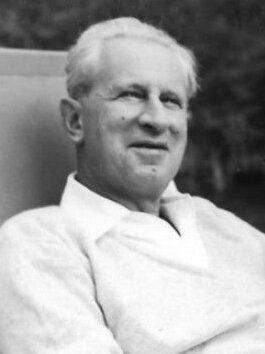
Born in Berlin in 1898, Herbert Marcuse fought in the First World War, studied philosophy with Heidegger and Husserl at Freiburg, and joined the Institute for Social Research. Exiled in the United States during Nazism — where he would live for the rest of his life — he became a university professor and, in the 1960s, the “guru of the New Left”: his ideas directly inspired the student movements of 1968, and Angela Davis was his student.
Marcuse crossed Marx with Freud. In Eros and Civilization (1955), he accepts that all civilization requires a certain repression of the instincts, but distinguishes the repression necessary for coexistence from “surplus repression” — the excess imposed by capitalist society to maintain alienated labor. His thesis is optimistic: technical advance would make possible, in principle, a non-repressive civilization, reconciled with desire and pleasure.
His most influential book, One-Dimensional Man (1964), is darker. Advanced industrial society, says Marcuse, neutralizes all opposition: it creates false needs, turns consumption into happiness, and absorbs criticism itself, producing a “one-dimensional” individual, incapable of imagining alternatives. Even liberal tolerance becomes “repressive,” tolerating everything equally and thereby disarming radical critique. Against this, Marcuse proposes the “Great Refusal” — the negation of the system in the name of an emancipated life. He was the voice of the Frankfurt School that most directly touched the politics of the streets.
Key Concepts
- Eros and Civilization (1955): returns to Freud — civilization requires repression of instincts, but Marcuse distinguishes necessary repression (minimal for coexistence) from surplus repression (capitalist excess for maintenance of alienated labor). A non-repressive civilization is possible
- One-Dimensional Man (1964): advanced industrial society integrates opposition — even criticism is absorbed and neutralized. “One-dimensional” man has lost the capacity to think negatively
- “Great Refusal”: refusal of the dominant principle of reality
- Repressive tolerance: liberal tolerance tolerates everything equally, neutralizing radical critique
Influenced by
- Hegel and Marx (via synthesis)
- Freud — drives and repression
- Heidegger — critique of technology (but criticizes Heidegger’s conservatism)
Influenced
- Student movements of 1968 (Paris, USA, Berlin)
- Feminist theory (Angela Davis was his student)
- Critical cultural studies
Works
Reason and Revolution (1941); Eros and Civilization (1955); One-Dimensional Man (1964).
See also
Twentieth Century Philosophy