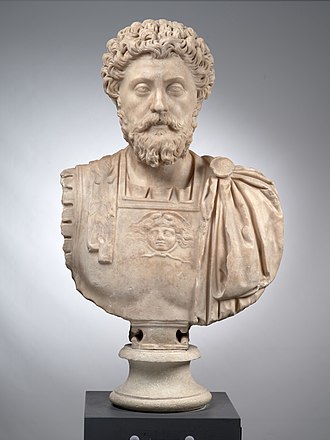
Marcus Aurelius Antoninus ruled Rome from 161 to 180 CE and is remembered as the last of the “Five Good Emperors” and as the most celebrated example of the ancient ideal of the philosopher-king. Adopted into the line of succession by Antoninus Pius, he received a careful education and turned early to Stoicism, above all through reading Epictetus, to whom he had been introduced by his teacher Junius Rusticus. His reign, far from peaceful, was beset by wars on the Danube frontier, by revolts, and by the devastating Antonine Plague — circumstances in which his philosophy proved less a doctrine than a discipline of inner survival.
The Meditations (Ta eis heauton, “to himself”), written in Greek and largely on military campaign, were not meant for publication: they are private notes, a journal of spiritual exercises in which the emperor exhorts himself to live according to reason. They contain no system, but the daily application of Stoic principles to his own life — which makes the work one of the most singular documents of antiquity.
At its core lies the inheritance of Epictetus: it is not things that disturb us, but the judgments we make about them (Enchiridion, V). It is within our power to govern those judgments, even if not events themselves — a distinction that frees us from anguish over what we cannot control. Awareness of death (memento mori) and of the transience of all things becomes a discipline: everything passes, and what matters is to live the present moment well, fulfilling one’s duty toward the human community. A cosmopolitan, Marcus Aurelius saw every person as a citizen of one and the same rational cosmos. Rediscovered in modern times, he became a touchstone for the idea of philosophy as a way of life (Pierre Hadot) and remains one of the most popular gateways into Stoicism.
Key Concepts
- Philosophy as daily practice of self-mastery
- “Men are disturbed not by things, but by the views they take of them” (cf. Epictetus, Enchiridion, V)
- Memento mori: awareness of mortality as discipline
- Cosmopolitanism and duty toward humanity
- Rational providence of the cosmos
Influenced by
- Epictetus — principal philosophical reference
- Zeno of Citium and Chrysippus of Soli
- Seneca (indirectly)
Influenced
- Modern political thought on the just ruler
- Movement of philosophy as a way of life (Pierre Hadot)
Works
Meditations (Ta eis heauton, ~12 books) — Portuguese trans. WMF Martins Fontes.
See also
Hellenistic Philosophy