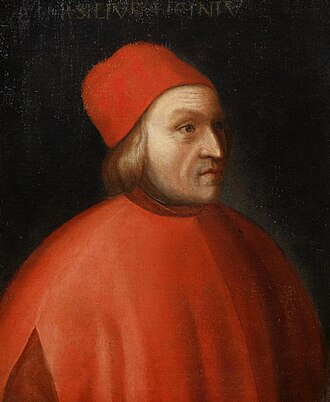
Italian philosopher and Catholic priest. Leader of the Platonic Academy of Florence under the patronage of Cosimo de’ Medici. He translated the entire works of Plato into Latin for the first time, as well as the Corpus Hermeticum and Plotinus.
Born in Figline Valdarno, Tuscany, in 1433, Ficino came of age in an environment shaped by the extraordinary cultural patronage of the Medici family. When Cosimo de’ Medici decided to establish a Platonic Academy modeled on antiquity, he entrusted its direction to Ficino and charged him with the monumental task of rendering Plato’s dialogues into Latin — a corpus virtually inaccessible to the medieval West — alongside the Neoplatonic writings of Plotinus, Iamblichus, and Proclus, and the recently rediscovered Corpus Hermeticum. This translation project, carried out between the 1460s and the 1490s, was decisive in reintroducing Platonic philosophy into European intellectual debate after centuries of Aristotelian dominance.
The central problem that animated Ficino’s entire body of work was demonstrating the deep compatibility — indeed, the profound harmony — between Platonic philosophy and Christian faith. To this end, he developed the doctrine of prisca theologia: the idea that a primordial wisdom, first revealed to Zoroaster, Hermes Trismegistus, and Orpheus, found its highest philosophical expression in Plato and reached its culmination in Christian revelation. His legacy runs through Renaissance humanism, directly influences Pico della Mirandola and Giordano Bruno, and lays the groundwork for the Hermetic and Neoplatonic tradition that would permeate all of early modern Europe.
Key Concepts
- Christian Neoplatonism: synthesis between Plato, Plotinus and late Neoplatonism with Christianity; human souls participate in the divine One through a hierarchy of being
- The soul as copula mundi: the human soul occupies the center of the hierarchy of being — between the superior angelic world and the inferior material world; it unites heaven and earth
- Platonic love (Commentarium in Convivium Platonis, 1469): love is the cosmic force that elevates the soul from sensible beauty to intelligible beauty and to God himself; he coined the expression amor platonicus
- Platonic theology (Theologia Platonica): the immortality of the soul proven philosophically — his principal philosophical project; demonstrates that Plato and Christianity agree on immortality
- Natural magic and astrology: the wise magus can attract beneficial astral influences; magic is natural philosophy (not demonological)
- Prisca theologia (ancient theology): there exists a perennial revelation that runs from Zoroaster and Hermes Trismegistus to Plato and Christianity — all reveal the same divine truth
Influenced by
- Plato — dialogues (central translator and interpreter)
- Plotinus — Enneads (translator)
- Corpus Hermeticum — hermeticism (translated at Medici’s request)
- Saint Augustine — Christian neoplatonism
Influenced
- Pico della Mirandola — direct disciple
- Giordano Bruno — magic, infinity and neoplatonism
- Renaissance humanism throughout Europe
- Western hermetic and esoteric tradition
Works
Theologia Platonica (1482); De Vita (1489); Commentarium in Convivium Platonis (1469); translations of Plato, Plotinus and Hermes Trismegistus.
See also
Humanism and Renaissance