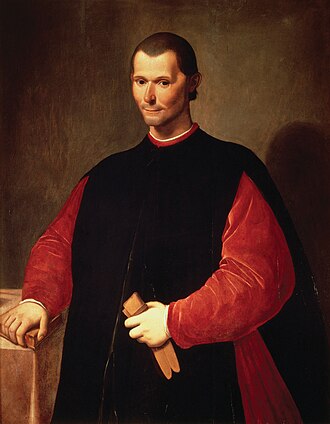
Born in Florence in 1469, Niccolò Machiavelli lived through the height and the crisis of the Italian Renaissance republics. For fourteen years he served as secretary of the Second Chancery of the Florentine Republic, on diplomatic missions that brought him before kings, popes, and the formidable Cesare Borgia — a direct experience of power that would mark all his thought. When the Medici returned in 1512, he was dismissed, imprisoned, and tortured on suspicion of conspiracy. It was then, in rural exile, that he wrote The Prince (1513). He is regarded as the founder of modern political science.
His decisive break lies in separating politics from morality. Instead of describing the ideal ruler, as the medieval treatises did, Machiavelli sets out from the “effective truth” of things — from how men actually act, not how they ought to act. Human nature, he says, is fickle and inclined to self-interest; the prudent ruler must know this and act accordingly, without illusions.
Hence his famous concepts. Virtù is the ruler’s capacity, energy, and cunning, who must unite the strength of the lion with the shrewdness of the fox; fortuna is unpredictable chance, which governs about half of events but can be contained by one who prepares, like a river that is channeled. In the choice between being loved or feared, it is safer to be feared — provided one is not hated. Often reduced to the cynicism of the adjective “Machiavellian,” Machiavelli is, in the Discourses on Livy, a republican thinker, and his influence reaches from Spinoza and Rousseau to Gramsci and all of modern political theory.
Key Concepts
- Political realism: politics must begin from how things are (essere), not how they should be (dover essere)
- Virtù: strength, skill, will, and cunning of the ruler — lion (strength) + fox (cunning)
- Fortuna: fortune governs half of events; virtù confronts the other half; fortune is like a river — it can be channeled
- Human nature: neither good nor bad, but tends toward evil when social restraints fail
- Consequentialism: the ends may justify the means in politics — “good crime” (once, to establish order) vs. “bad crime” (progressive, that disorders)
- Prophets armed vs. unarmed: the unarmed fail
- Governing is the art of being made to be loved or feared (in the choice, feared — but without being hated)
Influenced by
- Livy — Roman history as model
- Polybius — cycle of constitutions
- Florentine humanist tradition
Influenced
- Spinoza — read The Prince as a republican work
- Rousseau — republican interpretation
- Gramsci — the modern prince as political party
- Modern political science
Works
The Prince (1513, pub. 1532); Discourses on the First Decade of Livy (1517–31); The Art of War; History of Florence.
See also
Humanism and Renaissance