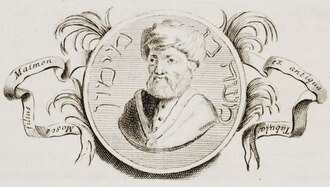
Moses ben Maimon — known by the acronym Rambam and, in the Latin West, as Maimonides — was born in Córdoba, in Al-Andalus, around 1138, and is the greatest Jewish philosopher of the Middle Ages. Fleeing Almohad persecution, his family wandered through North Africa before settling in Egypt, where Maimonides became a court physician and the spiritual leader of the Jewish community of Cairo. He was at once a jurist, a Talmudist, a physician, and a philosopher, and died in 1204.
Like Avicenna in Islam and, later, Thomas Aquinas in Christianity, Maimonides devoted himself to the reconciliation of faith and reason — between the philosophy of Aristotle, which he had received through the Arabic tradition, and the revelation of the Torah. His major philosophical work, the Guide for the Perplexed (1190), is addressed precisely to the one who, schooled in philosophy, finds himself perplexed before the apparent contradictions between reason and Scripture; the solution proposed is the allegorical interpretation of those biblical passages that ascribe human traits to God.
At the heart of his metaphysics lies negative theology: God’s essence is so radically transcendent that nothing positive can be affirmed of it without lowering it to human terms. We can only say what God is not. Maimonides also composed, in the Mishneh Torah, the most influential systematization of all Jewish law. His influence overflowed Judaism: he was read and cited by Thomas Aquinas (as “Rabbi Moyses”) and studied closely by Spinoza, who inherited from him impulses of both rationalism and biblical criticism.
Key Concepts
- Negative theology (via negativa): one cannot predicate positive attributes of God without anthropomorphizing him. We can only say what God is not — God is not ignorant (that is, he is wise), is not weak (he is powerful), etc. Divine essence is radically incomprehensible
- Guide for the Perplexed (More Nevukhim, 1190): work directed at the scholar who knows philosophy and is perplexed by the apparent contradictions between reason and Scripture; proposes allegorical interpretation of anthropomorphic biblical texts
- Prophecy: a natural phenomenon (not supernatural for other prophets) — occurs when the imagination and intellect of the prophet reach maximum perfection and the active intellect illuminates the acquired intellect; Moses is an exceptional case
- Creation vs. eternity of the world: against Aristotle who defended an eternal world; Maimonides argues that neither creation nor eternity are philosophically demonstrable — we accept creation by revelation
- Code of Jewish Law (Mishneh Torah): systematization of all Halakha (rabbinic law) in clear language — a juridical-theological monument
- Ethics of virtues: follows Aristotle — virtue is the mean between extremes; the human end is intellectual perfection as an imitation of God
Influenced by
- Aristotle — via Arabic translation, Al-Farabi, and Avicenna
- Avicenna — metaphysics and theory of prophecy
- Al-Farabi — Islamic political philosophy
Influenced
- Thomas Aquinas — cited extensively as “Rabbi Moyses”; negative theology
- Spinoza — biblical criticism and rationalism (read Maimonides carefully)
- Christian Scholasticism — transmission of Aristotelianism
- Later Jewish philosophy (Crescas, Albo)
Works
Mishneh Torah (1170–1180); Guide for the Perplexed (1190); Commentary on the Mishnah (1168); Epistle to Yemen (1172).
See also
Medieval Philosophy