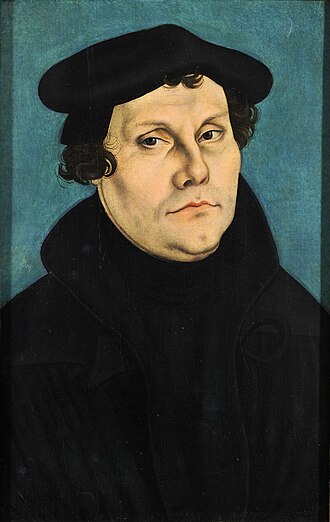
German Augustinian theologian; initiator of the Protestant Reformation. The 95 Theses (1517) against papal indulgences triggered a rupture that transformed Europe religiously, politically, and intellectually.
Key Concepts
- Justification by faith alone (sola fide): man is not saved by works, merits, or sacraments — only by faith in Christ; against the soteriology of merit in the Catholic Church
- Sola Scriptura: the Bible is the sole religious authority; tradition and papal decrees have no equivalent authority. He translated the Bible into German — founding modern literary German
- Priesthood of all believers: all baptized Christians are priests — dissolves the clerical hierarchy as necessary mediation between God and the faithful
- Two kingdoms (Zwei-Reiche-Lehre): the spiritual kingdom (governed by the Gospel) and the temporal kingdom (governed by law and the sword) — clear separation that influenced political secularization
- Christian freedom (On the Freedom of a Christian, 1520): “A Christian is a perfectly free lord of all things and subject to no one. A Christian is a perfectly dutiful servant of all things and subject to everyone” — paradox of inner freedom with service to one’s neighbor
- Against free will (On the Bondage of the Will, 1525): against Erasmus — human will is enslaved by sin; only irresistible divine grace can liberate; predestination
Influenced by
- Saint Augustine — grace, original sin, predestination
- Saint Paul — justification by faith (Romans, Galatians)
- William of Ockham — nominalism and critique of scholastic metaphysics
- Erasmus — textual humanism (but breaks with him)
Influenced
- Calvin — reformed reformation and absolute predestination
- Kant — moral autonomy (secularization of Lutheran individual conscience)
- Kierkegaard — radical and individual faith against the institution
- Secularization and European political modernity
- Hegel — Reformation as a moment of Spirit in history
Works
95 Theses (1517); On the Freedom of a Christian (1520); On the Babylonian Captivity of the Church (1520); On the Bondage of the Will (1525); Large and Small Catechisms (1529); Bible in German (NT: 1522; complete: 1534).
See also
Humanism and Renaissance