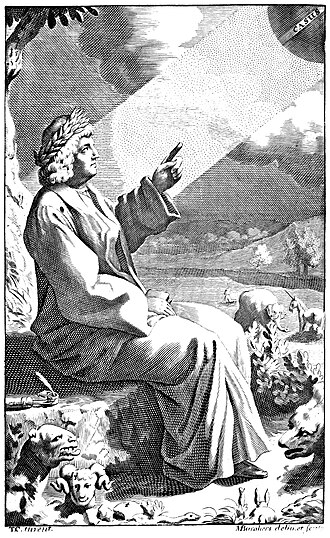
Roman poet and philosopher, author of De Rerum Natura (On the Nature of Things), the greatest philosophical poem of Antiquity. He systematized in Latin verse the physics and ethics of Epicurus, becoming the primary source for our knowledge of ancient Epicureanism. He defended atomism as an explanation of the universe, the mortality of the soul, and liberation from the fear of gods and death through rational understanding of nature.
Very little is known with certainty about his life: biographical details are scarce and come from late sources. De Rerum Natura was most likely composed during the 60s and 50s BCE, a period of acute political crisis in the Roman Republic — a context in which the Epicurean pursuit of ataraxia (tranquility of the soul) carried genuine existential urgency. The poem survived through a single line of medieval manuscripts and was rediscovered in 1417 by the humanist Poggio Bracciolini in a German monastic library, an episode narrated by Stephen Greenblatt in The Swerve (2011). That rediscovery exercised a significant influence on Renaissance thought and on the natural philosophy of the sixteenth and seventeenth centuries.
Lucretius’s philosophical project is fundamentally therapeutic: to show, through rational and poetic argument, that the two great human terrors — fear of divine interference in worldly affairs and fear of death — are illusions dissolved by knowledge of nature. By demonstrating that the universe operates through the impersonal laws of atoms and void, without divine providence, and that the soul perishes together with the body, Lucretius invites the reader toward philosophical serenity. The concept of the clinamen — the minimal, spontaneous swerve of atoms during their fall — is the pivotal element of this cosmology: it ensures that the world is not an absolutely deterministic mechanism and opens room for freedom within a wholly material nature.
Key Concepts
- Atomism: everything that exists is composed of atoms (corpora) and void (inane); nothing comes from nothing (ex nihilo nihil fit)
- Clinamen (declinatio): the spontaneous and unpredictable swerve of atoms in their fall — the foundation of freedom and indeterminacy in nature
- Mortality of the soul: the soul is material (composed of subtle atoms) and dissolves with the body — therefore there is no reason to fear death
- Anti-superstition: religion (religio) is a source of evils and terrors; philosophy liberates human beings from irrational fear of the gods
- Naturalistic explanation: phenomena such as lightning, earthquakes, and epidemics have natural causes, not divine ones
- Pleasure as absence of pain: faithfulness to Epicurean negative hedonism — happiness is ataraxia and aponia
Influenced by
- Epicurus — complete philosophical system (physics, ethics, canonic)
- Democritus — original atomism
- Empedocles — philosophical poetry about nature; literary model
Influenced
- Montaigne — skepticism and naturalism in the Essays
- Giordano Bruno — infinite universe and materialism
- Pierre Gassendi — revival of Epicurean atomism in the 17th century
- Modern science — mechanistic and corpuscular view of matter
Works
De Rerum Natura (On the Nature of Things) — poem in 6 books: I–II atomic physics; III the mortal soul; IV sensation and perception; V cosmology and history of civilization; VI meteorological phenomena and the plague of Athens.
See also
Hellenistic Philosophy