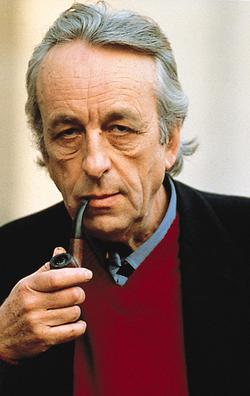
Louis Althusser (16 October 1918, Birmendreïs, French Algeria — 22 October 1990, La Verrière) was a French Marxist philosopher, the leading name of structural Marxism. A professor at the École Normale Supérieure on rue d’Ulm for decades, he trained and influenced an entire generation (Foucault, Derrida, Jacques Rancière, Étienne Balibar, Alain Badiou). A member of the French Communist Party from 1948, he devoted himself to a rigorous, “scientific” rereading of Marx against the humanist and historicist readings then dominant. His life was marked by severe mental illness: in 1980, during a psychotic episode, he killed his wife, Hélène Rytmann, and was declared unfit to stand trial.
Key Concepts
- The epistemological break (coupure épistémologique, a notion borrowed from Bachelard): there is a rupture between the young Marx, still ideological and humanist (close to Feuerbach), and the mature, scientific Marx, who from The German Ideology (1845) onward inaugurates a new science — that of the mode of production and of history.
- Theoretical anti-humanism: Marxism is not a humanism. History is a “process without a subject”; it is not Man, an abstract essence, who makes history, but social relations and structures. (A controversial thesis that earned Althusser the charge of dissolving the agent.)
- Overdetermination (surdétermination, a notion borrowed from Freud): no social contradiction is simple or pure; every contradiction is overdetermined by the other instances. Revolution does not erupt from an isolated economic contradiction, but from the “fusion” of several contradictions.
- Structural causality and the “last instance”: the social formation is a structured whole with relatively autonomous instances — economic, political, ideological. The economy is determinant “in the last instance” — but, as Althusser likes to say, “the lonely hour of the last instance never comes.”
- Ideology and Ideological State Apparatuses (ISAs, 1970 essay): besides the Repressive State Apparatus (police, army), capitalism reproduces itself through Ideological Apparatuses (school, church, family, media). Ideology is the “representation of the imaginary relationship of individuals to their real conditions of existence” and “has no history.”
- Interpellation: ideology “interpellates individuals as subjects.” The image is that of the policeman shouting “Hey, you there!” — on turning around, the individual recognizes himself as a subject and is already inside ideology.
Criticism
Althusser was charged with functionalism (the ISAs seem to explain everything through the reproduction of the system, leaving no room for resistance) and with “theoretical Stalinism” (E. P. Thompson, The Poverty of Theory). In his late work he sketched an “aleatory materialism,” or “materialism of the encounter,” revising his earlier scientism.
Influenced by
- Marx — the object of his “symptomatic” rereading
- Freud and Jacques Lacan — overdetermination and the interpellation of the subject
- Gaston Bachelard — the epistemological break
- Antonio Gramsci — hegemony and civil society (in critical dialogue)
Influenced
- Foucault, Derrida, Jacques Rancière, Étienne Balibar, Alain Badiou
- Nicos Poulantzas — the Marxist theory of the state
- Stuart Hall and Cultural Studies — the theory of ideology
- “Analytical Marxism” and contemporary debates on structure and agency
Works
For Marx (Pour Marx, 1965); Reading Capital (Lire le Capital, 1965, with Balibar and others); Lenin and Philosophy (1969); “Ideology and Ideological State Apparatuses” (1970); The Future Lasts Forever (posthumous autobiography, 1992).
See also
Marx, Antonio Gramsci, Jacques Lacan