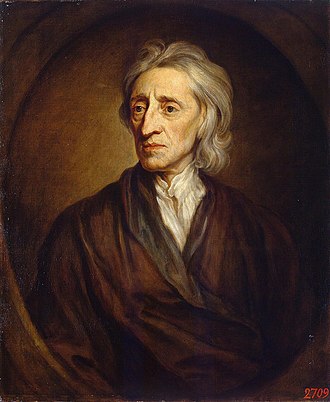
John Locke was born in Wrington, England, in 1632, was educated at Oxford, and practiced medicine before becoming secretary and physician to the Earl of Shaftesbury, which brought him into the orbit of high English politics. Caught up in the struggles between Parliament and the absolutist Stuart crown, he went into exile in Holland during the reign of James II and returned only in 1689, with the Glorious Revolution, which enshrined the parliamentary order he would help to justify philosophically. He is regarded as the father of classical liberalism and one of the greatest influences on empiricism and modern political thought.
In the Essay Concerning Human Understanding (1690), Locke attacks the doctrine of innate ideas: the mind at birth is a tabula rasa, a blank slate, and all knowledge comes from experience — whether from sensation (the external senses) or from reflection (the inner observation of the mind itself). He further distinguishes the primary qualities of bodies (extension, shape, motion), which belong to them objectively, from the secondary qualities (color, sound, taste), which depend on the perceiving subject.
In politics, set out in the Two Treatises of Government (1689), Locke holds that human beings possess, by nature, inalienable rights — to life, liberty, and property. Government arises from a contract founded on consent and exists only to protect those rights; when it violates them, the people have a legitimate right of resistance. A defender of the separation of powers and of religious toleration, Locke supplied the vocabulary of the modern revolutions: his ideas echo directly in the American Declaration of Independence (1776) and influenced Montesquieu, Rousseau, and Kant.
Key Concepts
- Tabula rasa: the mind at birth is a blank slate; all knowledge comes from experience (sensation + reflection). No innate ideas (against Descartes)
- Primary qualities (objective: extension, shape, motion) vs. secondary qualities (subjective: color, smell, taste)
- Inalienable natural rights: life, liberty, and property
- Social contract based on consent; if government violates natural rights → right to revolution
- Separation of powers: legislative (supreme) + executive/federative
- Religious tolerance: the State must not regulate conscience
Influenced by
- Francis Bacon — empirical method
- Descartes — as counterpoint
- Newton — scientific model
Influenced
- Hume — deepens empiricism
- Rousseau and Montesquieu — political theory
- American Declaration of Independence (1776) — Jefferson was Lockean
- Kant — rights and autonomy
Works
Essay Concerning Human Understanding (1690); Two Treatises of Government (1689); Letter Concerning Toleration (1689).
See also
Rationalism and Empiricism | Contractualism