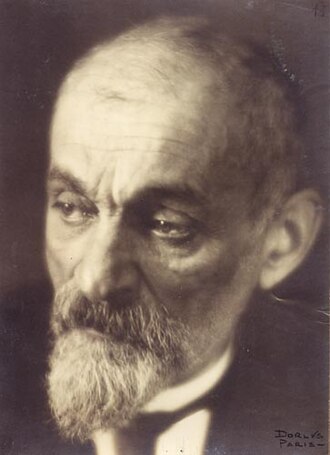
Lev Shestov — pen name of Yeguda Lev Shvartsman (Kiev, 5 February 1866 — Paris, 19 November 1938) — was a Russian philosopher who became one of the most radical voices in the critique of European philosophical rationalism. Born into a Jewish family in Kiev, he studied Law and Mathematics in Moscow before devoting himself entirely to philosophy. After the Bolshevik Revolution he emigrated, and in 1922 he was appointed lecturer in Russian philosophy at the University of Paris, a position he held until his death. It was during this productive exile that his most original ideas matured and he produced his defining work.
The central problem animating Shestov’s thought is the tyranny of reason over human existence. The entire Western philosophical tradition since the Greeks — from Plato to Hegel, from Aristotle to Kant — had, in his view, constructed an edifice of necessity, self-evident truths, and immutable laws that imprisons the human being within a determinism disguised as freedom. Against this edifice Shestov asserts a radical freedom anchored in faith: not a doctrinal faith, but the encounter with a living God capable of undoing even the past — the God of Abraham, Isaac, and Jacob, not the God of the philosophers. This contrast between Athens (reason, necessity, science) and Jerusalem (faith, contingency, the biblical God) gives its name to his magnum opus, published posthumously in 1938, and encapsulates his entire philosophical vision.
Key Concepts
- Athens and Jerusalem — the fundamental opposition between two ways of inhabiting the world: philosophical reason, which seeks eternal necessities and universal laws (Athens), and biblical faith, which lives by contingency, miracle, and personal relationship with the living God (Jerusalem). For Shestov, Western philosophy chose Athens and betrayed Jerusalem.
- Revolt against necessity — the authentic philosopher refuses to accept “self-evident truths” as a starting point; he rebels against every necessity imposed by reason or nature, affirming that for God all things are possible, including that what has happened might “not have happened.”
- The leap beyond reason — following the model of Kierkegaard, Shestov defends a leap that abandons rational certainties in favour of a faith that transgresses logic; but unlike Kierkegaard, he grounds this leap in the God of the Old Testament and the Hebrew biblical tradition.
- Dostoevsky and Nietzsche as masters of tragedy — in The Philosophy of Tragedy (1903), Shestov reads Dostoevsky and Nietzsche not as novelists or moralists but as thinkers of suffering and despair who arrived, through artistic creation, at truths that systematic philosophy is incapable of expressing.
- The Book of Job as a philosophical paradigm — in In Job’s Balances (1929), Shestov interprets Job’s revolt against God as the supreme model of authentic philosophical attitude: the refusal of every rational justification of suffering and a direct appeal to the God who stands beyond all necessity.
- Existential irrationalism — lived certainty precedes and surpasses philosophical systematisation; despair, anguish, and personal suffering are pathways to reality that no rational epistemology can provide.
Influenced by
- Dostoevsky — suffering as a source of knowledge; revolt against rational theodicy
- Nietzsche — radical critique of morality and systematic reason; the “death of God” as a point of departure
- Kierkegaard — the leap of faith, the singular individual before God, the critique of the Hegelian system
- Tolstoy — the search for a lived ethics beyond moral conventionalism (theme of his earliest writings)
- Blaise Pascal — the opposition between the God of the philosophers and the God of Abraham, Isaac, and Jacob
Influenced
- Nikolai Berdiáev — sustained dialogue on freedom, faith, and Russian existential philosophy
- Camus — critically analysed in The Myth of Sisyphus (1942): Camus acknowledges that Shestov discovered the absurd, but criticises him for committing “philosophical suicide” by escaping into religious faith rather than remaining within the absurd; Camus writes explicitly against Shestov and Kierkegaard, accusing both of making a “leap” toward God instead of sustaining lucid revolt
- Gilles Deleuze — a reference in discussions of immanence and transcendence
- Benjamin Fondane — his direct disciple, the Romanian-French poet and philosopher
- Emil Cioran — an avowed admirer; Shestov’s anti-rationalist stance resonates throughout Cioran’s work
Works
The Good in the Teaching of Tolstoy and Nietzsche (1899); The Philosophy of Tragedy: Dostoevsky and Nietzsche (1903); All Things are Possible (Apotheosis of Groundlessness, 1905); Potestas Clavium (1923); In Job’s Balances (1929); Kierkegaard and the Existential Philosophy (1933–1934); Athens and Jerusalem (written 1930–1937, published posthumously 1938).
See also
Nikolai Berdiáev, Kierkegaard, Camus, Nietzsche