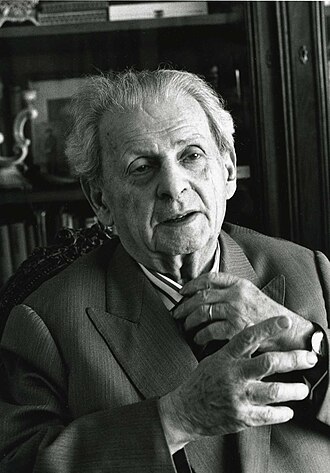
Lithuanian-French philosopher, one of the most important thinkers of the 20th century. He introduced Husserl and Heidegger to France, but later critically surpassed them. A Holocaust survivor, he developed a philosophy where ethics is first philosophy — prior to ontology.
Key Concepts
- The Face (le visage): the manifestation of the Other that addresses me and demands a response — not a physical face, but an ethical presence that says “thou shalt not kill”; the point from which all moral responsibility emerges
- Ethics as first philosophy: against Heidegger, for whom ontology (being) is the foundation of everything — for Lévinas, the ethical relation with the Other precedes and grounds all ontology
- Radical alterity (autrui): the Other cannot be reduced to the same, cannot be fully understood or assimilated — this irreducibility is the fundamental ethical fact
- Totality and Infinity: Western philosophy tends toward “totalization” — engulfing the different within the same. The Infinite breaks into this totality through the face of the Other, resisting capture
- Infinite responsibility: I am responsible for the Other asymmetrically and without reciprocity — “I am responsible even for what I did not do”; responsibility precedes freedom
- Il y a (there is): the experience of anonymous, impersonal, threatening being — the murmur of being before any existent; the night in which being becomes unbearable
- Saying and Said (le Dire / le Dit): “Saying” is ethical exposure to the Other, the act of address; the “Said” is propositional content — ethics resides in the Saying, which the Said always betrays
Influenced by
- Husserl — phenomenology (was his student and translator)
- Heidegger — fundamental ontology (later critically surpassed)
- Bergson — philosophy of duration and life
- Jewish tradition (Talmud, Rosenzweig, Buber)
Influenced
- Derrida — deconstruction and ethics (debate on violence and metaphysics)
- Habermas — ethics and recognition of the other
- Judith Butler — vulnerability and ethical responsibility
- Contemporary Christian and Jewish theology
- Postcolonial studies and recognition theory
Works
Existence and Existents (1947); Totality and Infinity (1961); Otherwise than Being (1974); Ethics and Infinity (1982).
See also
Twentieth-Century Philosophy