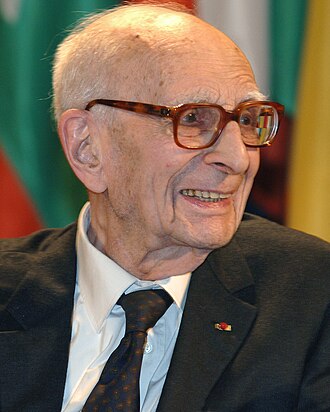
French anthropologist and philosopher; founder of structuralism in the human sciences. He applied Saussure’s model of linguistics to anthropology, transforming the study of myths, kinship, and “primitive” cultures.
Born in Brussels in 1908 and died in Paris in 2009, Lévi-Strauss studied philosophy and law before becoming a professor in Brazil — he taught at the University of São Paulo from 1935 to 1939, during which time he conducted fieldwork among indigenous peoples of Mato Grosso and the Amazon. That direct encounter with Amerindian societies proved decisive: rather than confirming the dominant evolutionist framework, it led him to question radically the hierarchy between “primitive” and “scientific” thought. After returning to Europe and spending the years of the Second World War in exile in New York, he came into close contact with the linguist Roman Jakobson, whose phonological formalism gave Lévi-Strauss the central methodological instrument: the analysis of binary oppositions as the key to deciphering cultural systems.
His most enduring contribution was to demonstrate that cultural phenomena — myths, rituals, kinship systems, cuisine, art — can be read as languages: sign systems whose meaning resides not in any single element but in the differential relations between them. In doing so, he shifted anthropology from a descriptive and historical discipline to a structural science of symbolic forms. The impact extended far beyond ethnology: it directly influenced Lacan’s psychoanalysis, Foucault’s historiography, narratology, and semiology, and triggered the central debate of twentieth-century French theory — the crisis of structuralism and its overcoming by the post-structuralism of Derrida and Deleuze.
Key Concepts
- Structuralism: behind the diversity of cultural phenomena lie universal unconscious structures of the human mind — binary, relational, transformational
- Myth: myths are not chaotic narratives but systems of binary oppositions (raw/cooked, nature/culture, high/low) that resolve existential contradictions in society
- Mythemes: the minimal units of a myth (analogous to phonemes in linguistics); meaning emerges from relations between mythemes, not from isolated elements
- The Raw and the Cooked (1964): the cooked is nature transformed by culture — cuisine is a universal symbolic system that encodes the nature/culture distinction
- Savage mind (La Pensée sauvage, 1962): the thought of “primitive” societies is not inferior — it is a science of the concrete, of the sensible, as rigorous as modern scientific thought
- Bricolage vs. engineering: the bricoleur uses elements at hand for new purposes; the engineer starts from abstract concepts — myth is a form of intellectual bricolage
- Kinship and exchange: kinship structures (incest prohibition, exogamy) are the foundation of all society — woman as sign in exchange between groups (later feminist critique)
Influenced by
- Ferdinand de Saussure — structural linguistics
- Marcel Mauss — anthropology of gift and exchange
- Marx — deep structures beneath the surface of phenomena
- Freud — unconscious and structure
Influenced
- Foucault — episteme as unconscious structure
- Derrida — deconstruction of structuralism
- Lacan — structuralist psychoanalysis
- Semiology and communication theory
- Narratology (Greimas, Genette)
Works
The Elementary Structures of Kinship (1949); Tristes Tropiques (1955); Structural Anthropology (1958); The Savage Mind (1962); Mythologiques (4 vols., 1964–1971).
See also
Twentieth-Century Philosophy