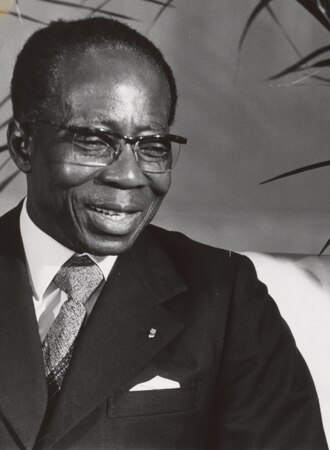
Léopold Sédar Senghor (9 October 1906, Joal, Senegal — 20 December 2001, Verson, France) was a poet, philosopher of culture, and statesman. The first president of independent Senegal (1960–1980) and the first African elected to the Académie française (1983), he was also, alongside Aimé Césaire and Léon-Gontran Damas, one of the founders of Négritude in 1930s Paris. While Césaire gave the movement its poetic force, Senghor set out to give it a systematic philosophical and aesthetic elaboration, making of it a general theory of the African contribution to human civilization. His work is today the object of both recognition and lively controversy.
Key Concepts
- Négritude: Senghor defined it as “the sum total of the cultural values of the black world.” This is not race in the biological sense but a shared cultural and civilizational heritage — a way of being in the world. Négritude answers colonial assimilation not by imitating the colonizer but by consciously reclaiming the African heritage.
- The thesis of a distinctive African mode of knowing: Senghor’s most famous and most debated formulation is the opposition between two ways of relating to the world — “emotion is African, as reason is Hellenic.” Senghor meant to valorize a knowledge by participation — intuitive, sympathetic, and rhythmic — proper to African sensibility, as distinct from European analytic and instrumental reason. He later qualified the formula (speaking of an “intuitive reason” and of complementarity rather than exclusion), but the thesis remained the most vulnerable point of his thought.
- The charge of inverted essentialism: precisely because he attributed to the “black soul” an intuitive, emotive essence, Senghor was accused — by Frantz Fanon, Wole Soyinka, and Paulin Hountondji, among others — of reproducing, even in an affirmative key, the very racial categories of colonial discourse. The debate over whether Négritude liberates or imprisons black identity is unavoidable in contemporary African thought.
- Civilization of the Universal (Civilisation de l’Universel): inspired by Teilhard de Chardin, Senghor projects a future convergence of cultures — not a flattening uniformity, but a “rendezvous of giving and receiving” in which each people contributes its own genius. Négritude would be, in this view, the African contribution to that concrete universal.
- African socialism and humanism: as a statesman, Senghor defended a socialism rooted in African communal values and in Christian personalism (Emmanuel Mounier), distinct from European materialist Marxism, articulating development, democracy, and cultural fidelity.
Influenced by
- Henri Bergson — intuition and duration as paths of knowledge
- Pierre Teilhard de Chardin — convergence and the Omega point
- Leo Frobenius — ethnological valuation of African civilizations
- Emmanuel Mounier — personalism
- Aimé Césaire — founding partnership of Négritude
Influenced
- The theorizing of African identity and aesthetics in the twentieth century
- The debate over ethnophilosophy and its critics (Hountondji, Towa)
- Pan-African cultural politics and Francophonie
- Frantz Fanon (through critique and rupture)
- Souleymane Bachir Diagne — contemporary rereading of Senghor and Bergson
Works
Chants d’ombre (poetry, 1945); Hosties noires (1948); Anthologie de la nouvelle poésie nègre et malgache de langue française (1948, with Jean-Paul Sartre’s preface “Orphée noir”); Éthiopiques (1956); Liberté I–V (essays, 1964–1993); Ce que je crois (1988).
See also
Aimé Césaire, Frantz Fanon