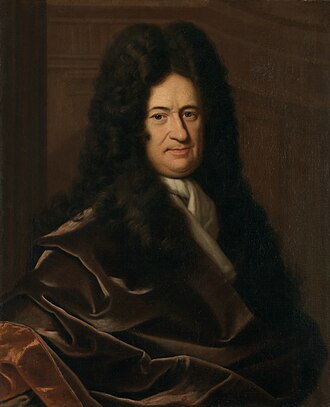
Born in Leipzig in 1646, Gottfried Wilhelm Leibniz was the last great universal sage: at once philosopher, mathematician, logician, physicist, jurist, historian, and diplomat. He invented — independently of Newton — the infinitesimal calculus, whose notation we still use, conceived the binary arithmetic that underlies computing, and designed calculating machines. He spent much of his life in the service of the House of Hanover and died in 1716, leaving a body of work scattered across thousands of letters and few published books. Philosophically, he sought the great reconciliation of modern science, the metaphysical tradition, and faith.
At the center of his metaphysics are the monads: simple, immaterial, indivisible substances, “without windows,” of which everything is composed. Each monad does not interact directly with the others but mirrors, from its own point of view, the entire universe. How, then, to explain the order of the world and the relation between soul and body? Through pre-established harmony: God adjusted all monads from the beginning, like synchronized clocks, so that their perceptions coincide.
Two great principles sustain his system: the principle of sufficient reason (nothing exists or happens without a reason that explains it) and that of the identity of indiscernibles. From them derives his most famous thesis: since God is perfect and chooses according to reason, this can only be the best of all possible worlds — the one that reconciles the maximum of perfection with the inevitable existence of evil, the theme of his Theodicy (later satirized by Voltaire in Candide). His project of a characteristica universalis, a universal logical language, anticipates Frege and modern symbolic logic.
Key Concepts
- Monads: simple, immaterial substances, without windows — each one mirrors the entire universe from its point of view
- Pre-established harmony: God programmed all monads so that their perceptions coincide — solution to the mind-body problem without interaction or occasionalism
- Principle of sufficient reason: nothing happens without sufficient reason
- Principle of identity of indiscernibles: two absolutely identical objects are the same object
- Best of all possible worlds: God created the world with maximum perfection compatible with the existence of evil — Theodicy
- Co-inventor of infinitesimal calculus (independently of Newton)
- Project of characteristica universalis: universal formal language of thought (anticipates Frege and symbolic logic)
Influenced by
- Descartes — dualism to overcome
- Spinoza — monism as a problem
- Plato — Forms as reasons of things
- Aristotle — substance, form, entelechy
Influenced
- Kant — responds to the empiricism of Hume via Leibniz
- Hegel — dialectic as internal development
- Frege — symbolic logic
- Russell — Philosophy of Leibniz
- Computer science: binary logic (0/1 as monads)
Works
Discourse on Metaphysics (1686); New Essays (1704); Theodicy (1710); Monadology (1714).
See also
Rationalism and Empiricism