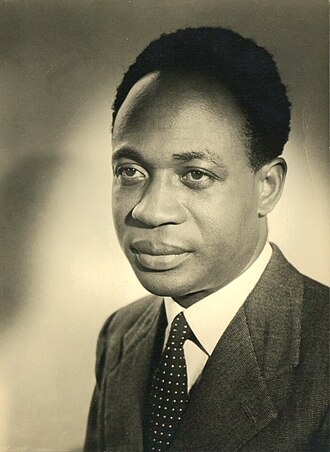
Kwame Nkrumah (21 September 1909 – 27 April 1972) was born in Nkroful, Gold Coast (present-day Ghana). He studied in the USA (Lincoln University and University of Pennsylvania) and the United Kingdom (London School of Economics), where he developed his Pan-Africanist ideas in contact with figures such as C.L.R. James and George Padmore. He returned to the Gold Coast in 1947, led the independence movement, and became the first president of Ghana in 1957 — the first sub-Saharan African country to gain independence in the postwar period. He was deposed in a military coup in 1966 while in Beijing, en route to Hanoi. He spent the rest of his life in exile in Guinea-Conakry, where he died in 1972. Nkrumah is regarded as one of the founding fathers of modern Pan-Africanism and a central figure of the Organisation of African Unity (founded 1963).
Key Concepts
Pan-Africanism: the idea that African peoples and the African diaspora share a common identity and destiny and must unite politically to overcome colonialism and neocolonialism. Nkrumah advocated for the creation of a unified continental African government — a position that put him at odds with other African leaders who preferred a gradualist interstate approach.
Neocolonialism (Neo-Colonialism: The Last Stage of Imperialism, 1965): Nkrumah coined and systematized the concept of neocolonialism — the situation in which a state formally obtains political independence but remains economically subordinated to the interests of former colonial powers and multinational corporations. Neocolonialism is, for Nkrumah, the most dangerous form of imperialism: it operates without visible colonial presence, through economic, financial, and cultural mechanisms.
Consciencism (Consciencism: Philosophy and Ideology for Decolonization and Development, 1964): Nkrumah’s most systematic philosophical work. “Consciencism” is a philosophy seeking synthesis among three elements present in contemporary African society: (1) traditional African heritage, with its communalist and egalitarian basis; (2) Islamic heritage, with its values of solidarity and moral law; (3) the European-Christian heritage, with its humanism and certain technical achievements. The synthesis is not eclecticism: it is a dialectical transformation oriented toward recovering the original African “thread” — communalism — which Nkrumah identifies with socialism.
African Socialism: for Nkrumah, socialism is not imported: traditional African societies practiced forms of collective land ownership and solidary organization that constitute the cultural basis for a modern African socialism. But this socialism must be scientific (Marxist in its analysis of productive forces) and not merely sentimental.
Critique of Senghor’s and Nyerere’s “African socialism”: Nkrumah criticizes versions of African socialism that reduce it to traditional cultural values without analysis of social classes and imperialism. To ignore classes is political naivety that benefits national bourgeoisies and neocolonial powers.
African unity as a condition of development: Africa’s fragmentation into multiple small, dependent states is a direct result of colonial borders and “divide and rule.” Without continental political unity, no African state can industrialize, resist economic imperialism, or exercise real sovereignty.
Influenced by
- Marcus Garvey — Pan-Africanism and Black pride
- W.E.B. Du Bois — double consciousness, Pan-Africanism
- C.L.R. James — Caribbean Marxism, history of the African diaspora
- Marx and Lenin — analysis of imperialism and capitalism
- George Padmore — socialist Pan-Africanism
Influenced
- African liberation movements (Angola, Mozambique, Zimbabwe)
- Organisation of African Unity (OAU, 1963) / African Union (2002)
- The concept of neocolonialism (widely adopted in postcolonial studies)
- Amílcar Cabral and Thomas Sankara
- Contemporary debates on African development
Works
Towards Colonial Freedom (1945, written 1942); Ghana: The Autobiography of Kwame Nkrumah (1957); I Speak of Freedom (1961); Africa Must Unite (1963); Consciencism: Philosophy and Ideology for Decolonization and Development (1964); Neo-Colonialism: The Last Stage of Imperialism (1965); Class Struggle in Africa (1970).
See also
African Philosophy