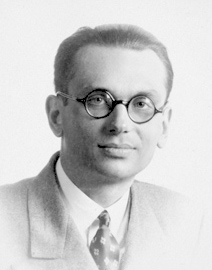
Kurt Gödel is widely regarded as the greatest logician since Aristotle. Born in Brünn (now Brno, Czech Republic) on 28 April 1906, and died in Princeton on 14 January 1978, his work fundamentally transformed mathematical logic, the foundations of mathematics, and the philosophy of mind. His two Incompleteness Theorems (1931) partially dismantled David Hilbert’s formalist programme and established intrinsic limits to any sufficiently powerful axiomatic system.
Key Concepts
First Incompleteness Theorem (Über formal unentscheidbare Sätze der Principia Mathematica und verwandter Systeme I, 1931): Gödel proved that any consistent formal system capable of expressing elementary arithmetic necessarily contains propositions that can neither be proved nor refuted within the system itself. The proof strategy is remarkably ingenious: Gödel encoded formal syntax by means of numbers (the so-called Gödel numbering), thereby constructing a sentence that, in its own arithmetic numbering, asserts “I am not provable in this system.” If the system could prove this sentence, it would be inconsistent; since it cannot, the sentence is true yet undecidable. The theorem showed that completeness — the capacity of a formal system to decide every well-formed proposition — is incompatible with consistency, for sufficiently expressive systems.
Second Incompleteness Theorem (same paper, 1931): A direct extension of the first: no sufficiently powerful consistent formal system can prove its own consistency using only the resources available within the system. This struck directly at Hilbert’s programme (Hilbertprogramm), which sought to secure the foundations of mathematics through finitary consistency proofs. The second theorem showed that such a proof is in principle impossible — unless the system is inconsistent (in which case it would prove anything).
Completeness Theorem (doctoral thesis, University of Vienna, 1929; published 1930): Distinct from the incompleteness theorems, this positive result demonstrates that first-order logic (predicate calculus) is complete: every logically valid formula (true in every model) is derivable through formal proof rules. This established the adequacy of the inference rules of classical predicate logic.
Relative Consistency of the Axiom of Choice and the Continuum Hypothesis (1938–1940): Gödel showed that if Zermelo-Fraenkel set theory (ZF) is consistent, then adding the Axiom of Choice (AC) and the Generalised Continuum Hypothesis (GCH) introduces no inconsistency. He constructed for this purpose the “constructible sets” (constructible universe, L), showing they form a model of ZF+AC+GCH. Paul Cohen would prove in 1963 the independence in the opposite direction, completing the result: AC and CH are independent of ZF.
Modal Ontological Proof (formulated in the 1970s, published posthumously by Sobel in 1987): Gödel formalised in second-order modal logic a version of Anselm of Canterbury’s ontological argument, using the concepts of “positive” property and modal necessity. The formalisation was a personal philosophical curiosity of Gödel’s, never published by him in his lifetime, and remains the subject of intense debate concerning its logical validity and ontological premises.
Mathematical Platonism: Gödel held a realist philosophy of mathematics: mathematical objects (numbers, sets, functions) exist independently of the human mind and of formal constructions. Mathematical intuition would be a kind of perception of abstract entities. This position stands in productive tension with the incompleteness results — if mathematics were mere symbol manipulation, why should we accept the Gödelian sentence as true (rather than merely undecidable)? The Platonist answer is: because we perceive it as true through intuition, even without formal proof.
Influenced by
- David Hilbert — formalist programme (target and point of departure)
- Bertrand Russell and Alfred North Whitehead — Principia Mathematica (the system whose limitations Gödel explored)
- Ernst Zermelo and Abraham Fraenkel — axiomatic set theory
- Leibniz — interest in formal logic and the ontological argument
- The Vienna Circle (attended meetings; never a logical positivist, but engaged with Carnap and Schlick)
Influenced
- Alfred Tarski — theory of truth and undecidability
- Alan Turing — Gödel’s theorems directly inspired the concept of the undecidable problem and the formulation of the Turing machine (1936)
- John von Neumann — immediately recognised the importance of the results in 1930
- Philosophy of mind: Lucas (1961) and Penrose (The Emperor’s New Mind, 1989) used the theorems to argue against mechanism; the position was rebutted by Putnam and others
- Contemporary modal logic and proof theory
- Debates on the foundations of mathematics (constructivism, Platonism, formalism)
Works
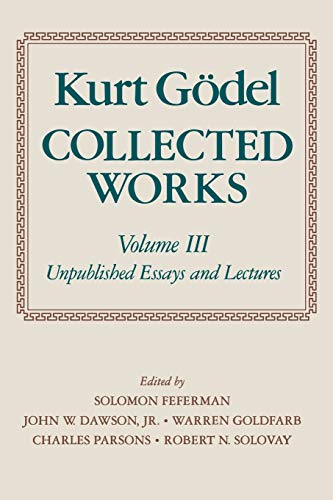
Über die Vollständigkeit des Logikkalküls (doctoral thesis, 1929; published 1930); Über formal unentscheidbare Sätze der Principia Mathematica und verwandter Systeme I (1931); The Consistency of the Axiom of Choice and of the Generalized Continuum Hypothesis with the Axioms of Set Theory (1940); What is Cantor’s Continuum Problem? (1947; revised 1964); Russell’s Mathematical Logic (1944); Collected Works (5 vols., ed. Feferman et al., Oxford University Press, 1986–2003).
See also
Mathematical Logic Philosophy of Mathematics Bertrand Russell Ludwig Wittgenstein
Recommended books:
 Gödel's Proof — Ernest Nagel and James R. Newman
Ver na Amazon →
Gödel's Proof — Ernest Nagel and James R. Newman
Ver na Amazon →
 Collected Works, Vol. I — Kurt Gödel
Ver na Amazon →
Collected Works, Vol. I — Kurt Gödel
Ver na Amazon →