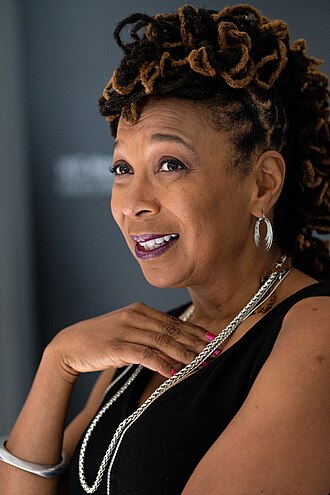
Kimberlé Williams Crenshaw (born 1959 in Canton, Ohio) is an American legal scholar and professor of law at UCLA and Columbia University. She is one of the founders of Critical Race Theory and the author who coined the concept of intersectionality, now central to gender studies, race studies, and political philosophy, but originally formulated within antidiscrimination law.
The problem she starts from is practical and legal. Analyzing discrimination cases — especially DeGraffenreid v. General Motors (1976), in which Black women were left legally unprotected because the company hired (white) women and (male) Black workers — Crenshaw showed that single-axis frameworks (discrimination either by race or by gender) rendered invisible the situation of those who stand at the intersection of more than one axis.
Her theoretical proposal is therefore that oppressions do not add up linearly: they intersect and mutually transform one another, generating specific experiences. A highly influential concept, intersectionality is also the object of criticism — for alleged methodological vagueness and for, taken to an extreme, fragmenting the political subject — a debate she and her successors seek to address.
Key Concepts
- Intersectionality (“Demarginalizing the Intersection of Race and Sex,” 1989; “Mapping the Margins,” 1991): the thesis that axes of oppression (race, gender, class, sexuality) intersect and cannot be treated in isolation; those at the intersection suffer a distinct discrimination, not the mere sum of the parts.
- Critique of the “single axis”: antidiscrimination law and much of social theory presuppose pure categories (the white “woman,” the male “Black”), rendering compound cases invisible.
- Critical Race Theory: a legal current analyzing how law produces and maintains racial hierarchies, beyond individual intent.
- #SayHerName: a campaign she helped articulate to give visibility to Black women who are victims of police violence.
Influenced by
- The Black feminist tradition (from Sojourner Truth to the Combahee River Collective)
- Critical Legal Studies and the jurist Derrick Bell
- The civil rights movement and critical social theory
Influenced
- Gender studies, race studies, and contemporary political philosophy
- Public policy and the vocabulary of the debate on inequality
- Antidiscrimination law
Works
“Demarginalizing the Intersection of Race and Sex” (1989); “Mapping the Margins” (1991); co-editor of Critical Race Theory: The Key Writings (1995).
See also
Gayatri Spivak, Judith Butler, Simone de Beauvoir