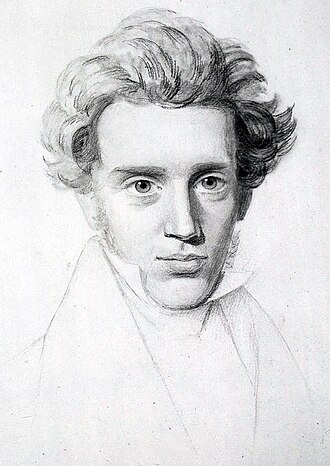
Danish philosopher; the “father of existentialism”. Wrote frequently under pseudonyms to present opposing perspectives. His philosophy is a reaction to Hegel’s speculative system and the bourgeois comfort of institutional Christianity.
Key Concepts
- Three stages of existence:
- Aesthetic: life oriented toward pleasure, novelty, aesthetics — the despair of inevitable boredom
- Ethical: commitment to duty, universal morality, marriage — the despair of unforgivable guilt
- Religious: suspension of the ethical by the singular before God — the “leap of faith” beyond reason
- Anxiety (Begrebet Angest, 1844): human freedom as “vertigo of possibility”; anxiety has no determinate object (unlike fear) — it is dizziness before the abyss of the possible
- Despair (The Sickness Unto Death, 1849): unwilling to be oneself, or willing to be other than oneself — the universal condition of humanity without relation to God
- Subjectivity (“Subjectivity is truth”): existential truth is not attained through Hegel’s objective speculation, but through subjective and passionate commitment
- Leap of faith: Abraham who goes to sacrifice Isaac — an act that suspends the ethical and makes sense only before the singular of God; Camus criticizes it as “philosophical suicide”
- Pseudonyms: Victor Eremita, Johannes Climacus, Anti-Climacus, Constantine Constantius — each represents a stage or perspective
Influenced by
- Hegel — point of departure and principal adversary; rejects the speculative system
- Socrates — irony and indirect method; identified with him
- Plato — dialogues and Socratic position
- Luther — individual faith against institution
Influenced
- Heidegger — anxiety, authenticity, being-toward-death
- Sartre — radical freedom, bad faith, existential project
- Camus — the absurd (but rejects Kierkegaard’s leap of faith)
- Simone de Beauvoir — concrete existential situation
- Existential theology (Karl Barth, Paul Tillich)
Works
Either/Or (1843); Fear and Trembling (1843); The Concept of Anxiety (1844); Stages on Life’s Way (1845); Philosophical Fragments (1844); The Sickness Unto Death (1849); The Point of View for My Work as an Author (1859, posthumous).
See also
Nineteenth-Century Philosophy