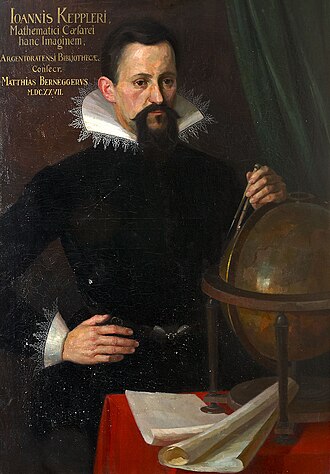
Born in Weil der Stadt, Germany, in 1571, Johannes Kepler was a fascinating spirit of transition: a devout Protestant, he studied theology at Tübingen but devoted his life to astronomy, convinced that to decipher the order of the heavens was to read the mind of God. He worked as assistant to the great observer Tycho Brahe in Prague and, on inheriting his data of the highest precision — especially on Mars — had at his disposal the material that would make his discoveries possible.
From this data, Kepler took a step that not even Copernicus had dared: he abandoned the perfect circle. His three laws of planetary motion establish that planets describe ellipses (not circles) with the Sun at one focus; that they sweep out equal areas in equal times (moving faster near the Sun); and that there is an exact mathematical relationship between the period and the distance of each planet. For the first time, celestial motion obeyed precise and universal mathematical laws.
Kepler retained, it is true, a Neopythagorean soul: he believed in a “harmony of the spheres,” a mathematical music of the cosmos (Harmonices Mundi). But he was also a pioneer in seeking a physical cause for the motion of the planets — a force emanating from the Sun — anticipating the idea of gravitation. His three laws were exactly what Newton would come to explain with universal gravitation, making Kepler the decisive link between Copernicus and modern physics.
Key Concepts
- First Law: planets orbit the Sun in elliptical paths, with the Sun at one of the foci of the ellipse
- Second Law: the line connecting the planet to the Sun sweeps out equal areas in equal times (planets move faster when they are close to the Sun)
- Third Law: the square of the orbital period is proportional to the cube of the semi-major axis of the orbit — universal mathematical relationship among all planets
- Harmony of the spheres: Kepler maintained a Neopythagorean vision — planets produce a mathematical “music” (Harmonices Mundi, 1619)
- Celestial physics: sought a physical cause for planetary motion (force of the Sun) — precursor to the idea of gravity that Newton would formalize
- Optics: conceived the optical design of the Keplerian telescope; theory of refraction of vision
Influenced by
- Copernicus — heliocentrism (starting point)
- Tycho Brahe — precise observational data (worked with Brahe)
- Plato and Pythagoras — mathematical harmony of the cosmos
Influenced
- Newton — Kepler’s three laws were what Newton explained with universal gravitation
- Modern astronomy and astrophysics
- Galileo — contemporary, despite little direct contact
Works
Mysterium Cosmographicum (1596); Astronomia Nova (1609, 1st and 2nd laws); Harmonices Mundi (1619, 3rd law); Epitome Astronomiae Copernicanae (1618–1621).
See also
Scientific Revolution