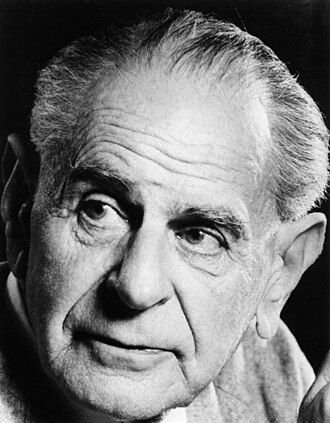
Austrian-British philosopher. Proposed falsificationism as a criterion for scientific demarcation and defended the open society against totalitarianism. Sharp critic of Marxism and historicism.
Born in Vienna in 1902, Popper came of age in intellectual contact with the Vienna Circle — the group of philosophers and scientists who sought to ground knowledge in strict verificationist terms. Rather than joining their programme, however, he turned the question around: the central problem of epistemology is not how we confirm theories, but how we distinguish genuine science from pseudo-science. His answer, falsificationism, holds that the hallmark of a scientific theory is its refutability: a claim is scientific if and only if it is possible to conceive of an observation or experiment that could prove it wrong. This methodological reorientation, set out in The Logic of Scientific Discovery (1934), reshaped the foundations of twentieth-century philosophy of science.
The European political upheavals of the 1930s and 1940s — the rise of Nazism and the expansion of Stalinism — prompted Popper to extend his critical rationalism into the social realm. In The Open Society and Its Enemies (1945), written in exile in New Zealand during the Second World War, he argued that the major totalitarian ideologies shared a common philosophical root: historicism, the belief in necessary laws governing the course of history. Against this, Popper championed piecemeal social engineering — gradual, testable, and reversible reforms in place of revolutionary utopias. His political philosophy shaped generations of liberals and democrats, and remains a central reference in debates about science, democracy, and freedom.
Key Concepts
- Falsifiability (The Logic of Scientific Discovery, 1934): a scientific theory is not one that can be verified (induction — the problem of Hume), but one that can be falsified — that admits the possibility of being refuted by experiments. Psychoanalysis and Marxism are not sciences: they are immune to refutation
- Problem of induction (asymmetrical solution): no number of observations confirms a universal law; a single counterexample falsifies it. Science progresses through the survival of the most audacious theories under severe scrutiny
- Critical rationalism: reason advances through bold conjectures and rigorous refutations — not through secure inductive accumulation
- Evolutionary epistemology: the growth of knowledge is analogous to biological evolution — variations (conjectures) eliminated by selection (refutation)
- Open Society (The Open Society and Its Enemies, 1945): societies that permit criticism, reform, and peaceful change of institutions; critique of Plato, Hegel, and Marx as “enemies” — historicisms that believe in inevitable laws of history and justify authoritarianism
- Historicism: the belief that there are historical laws that allow us to predict the future — Popper argues it is a dangerous fallacy; the future is open
Influenced by
- Kant — limits of knowledge and the active role of the subject
- Hume — problem of induction (point of departure)
- Einstein — science as bold, refutable conjecture
Influenced
- Contemporary philosophy of science (Lakatos, Feyerabend — disciples and critics)
- Thomas Kuhn (debate on scientific progress)
- Contemporary political liberalism
- George Soros — applied the “open society” as a political and philanthropic project
Works
The Logic of Scientific Discovery (1934); The Poverty of Historicism (1957); The Open Society and Its Enemies (1945); Conjectures and Refutations (1963); Objective Knowledge (1972).
See also
Twentieth Century Philosophy