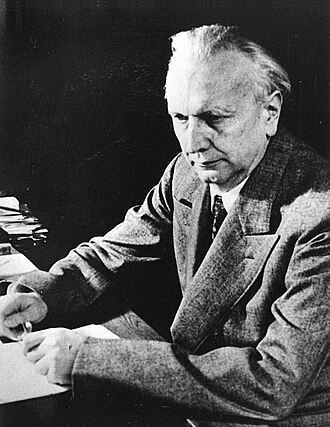
German psychiatrist and philosopher, one of the central figures of the philosophy of existence alongside Heidegger and Kierkegaard. He moved from psychiatry (General Psychopathology, 1913) to philosophy, developing a reflection on human existence centered on boundary situations, existential communication, and transcendence. He was Hannah Arendt’s mentor at Heidelberg. After World War II, he became an influential voice on the question of German guilt and the ethical foundations of politics.
Key Concepts
- Existence (Existenz): the human being is not a mere object — it is freedom, possibility, decision; existence cannot be captured by scientific categories
- Boundary situations (Grenzsituationen): death, suffering, struggle, guilt — inescapable situations that reveal finitude and awaken consciousness to transcendence
- Ciphers of transcendence: transcendence (the Encompassing, das Umgreifende) cannot be known directly but manifests through ciphers — symbols, myths, limit-experiences
- Existential communication: truth is not reached in isolation but in authentic dialogue between free existences — it requires openness, risk, and mutual recognition
- The Encompassing (das Umgreifende): the being that surrounds and exceeds all objectification — it unfolds in modes: being-there, consciousness in general, spirit, existence, world, transcendence
- Axial Age (Achsenzeit): the period between ~800 and 200 BCE when, simultaneously and in independent civilizations (Greece, Israel, India, China), the spiritual foundations of humanity emerged — Socrates, Buddha, Confucius, the prophets of Israel
- Philosophical faith: distinct from revealed religious faith — it is trust in reason and openness to transcendence without dogma
Influenced by
- Kant — limits of reason, phenomenon/thing-in-itself distinction
- Kierkegaard — existence, subjectivity, leap of faith
- Nietzsche — critique of culture, authenticity
- Max Weber — interpretive sociology, disenchantment of the world
- Plotinus — transcendence and the One
Influenced
- Hannah Arendt — thesis advisor; communication and political action
- Habermas — communicative reason (though by distinct paths)
- Paul Ricoeur — hermeneutics and existence
- Existential and phenomenological psychiatry
Works
General Psychopathology (1913); Philosophy (3 vols., 1932: Philosophical World Orientation / Existential Elucidation / Metaphysics); Reason and Existence (1935); The Question of German Guilt (1946); The Origin and Goal of History (1949); Way to Wisdom: An Introduction to Philosophy (1950); The Great Philosophers (1957).
See also
Twentieth Century Philosophy