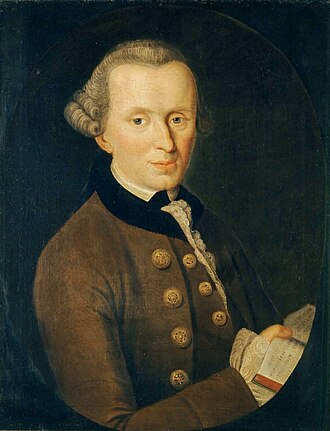
Born in Königsberg, in East Prussia, in 1724, and never having strayed from his native city, Immanuel Kant led the methodical life of a university professor — so regular, tradition holds, that his neighbors set their clocks by his daily walk. It was, in his own words, the reading of Hume that “awakened him from his dogmatic slumber” and led him into a long decade of silence, at the end of which, already 57 years old, he published the monumental Critique of Pure Reason (1781). His work both closes and refounds Modernity, mediating the dispute between the rationalism of Descartes and the empiricism of Hume.
The central question of the first Critique is: how are synthetic a priori judgments possible — propositions that extend knowledge and yet hold universally and necessarily, as in mathematics and physics? The answer is the “Copernican revolution”: it is not knowledge that conforms to objects, but objects that conform to the a priori structures of the subject. Space and time are forms of sensibility; the categories (causality, substance…) are forms of the understanding. We therefore know only the phenomenon — the thing as it appears — never the thing-in-itself (Ding an sich). From this follows the decisive limit: reason that tries to go beyond possible experience (to prove God, the soul, the world as a totality) falls into illusion — traditional metaphysics, as a science, is impossible.
But what theoretical reason cannot demonstrate, practical reason demands. In the moral sphere, Kant founds the ethics of autonomy: the rational will gives itself the law, condensed in the categorical imperative — “act only according to that maxim whereby you can at the same time will that it become a universal law.” From this derives dignity: rational beings are ends in themselves, never mere means; they have worth, not price. Closing the Critique of Practical Reason, Kant confesses what filled his mind with ever-new admiration: “the starry heavens above me and the moral law within me.” His influence is inescapable — from Fichte, Schelling, and Hegel to Schopenhauer, Nietzsche, and Rawls.
Key Concepts
- Copernican Revolution: not the subject adapting to objects, but objects adapting to the a priori forms of the subject (space, time, categories)
- Synthetic a priori judgments: universal, necessary, and extend knowledge — foundation of science
- Thing-in-itself (Ding an sich): reality as it is, independent of us — unknowable
- Transcendental Aesthetic: space and time are a priori forms of sensibility
- Transcendental Analytic: 12 categories of understanding (causality, substance, etc.)
- Transcendental Dialectic: reason produces illusions when it exceeds possible experience → metaphysics as science is impossible
- Categorical Imperative: “Act only according to that maxim whereby you can at the same time will that it should become a universal law”
- Autonomy: practical reason gives itself the law — does not receive it from outside
- Human dignity: rational beings have absolute value, not price
- Practical postulates: freedom, immortality, and God — not demonstrable, but required by the moral law
Influenced by
- Hume — “awakened me from dogmatic slumber”
- Rousseau — “the Newton of the moral world”
- Leibniz — rationalism
- Newton — model of science
Influenced
- Fichte — radicalizes the transcendental subject
- Schelling and Hegel — absolute idealism
- Schopenhauer — thing-in-itself as Will
- Marx — critique as method
- Nietzsche — destruction of metaphysical foundations
- Husserl — transcendental consciousness
- Rawls — Kantian contractarian ethics
Works
Critique of Pure Reason (1781/87); Groundwork for the Metaphysics of Morals (1785); Critique of Practical Reason (1788); Critique of Judgment (1790); Perpetual Peace (1795).
See also
Contractualism, Enlightenment and Kant