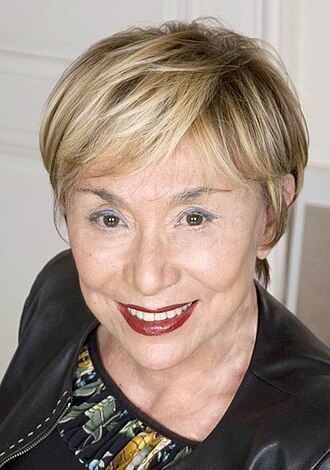
Julia Kristeva (born 24 June 1941 in Sliven, Bulgaria) is a Bulgarian-French philosopher, psychoanalyst, linguist, semiotician, and novelist. She arrived in Paris in 1965 on a doctoral fellowship and soon joined the group around the journal Tel Quel, the epicenter of the French intellectual avant-garde. She became a professor at the University of Paris VII and a practicing psychoanalyst. Her work cuts across linguistics, literary theory, psychoanalysis, and philosophy, with a strong debt to Bakhtin, Saussure, and Lacan.
The problem that guides her is that of the limits of language itself: what, in meaning, escapes the order of the sign and of syntax? Against a structuralism that treated language as a closed system, Kristeva looks for what in it is body, drive, and rhythm — what destabilizes it from within. Hence her attention to poetic language, to the avant-garde text, and to the subject’s limit-experiences.
In a psychoanalytic key, she shifts the focus from the pure signifier to the subject in process, traversed by forces that precede and exceed consciousness. Her relation to feminism is ambivalent: associated with so-called “French feminism,” she refused essentialism and the label, proposing (in “Women’s Time,” 1979) a reading of the movement in three generations.
Key Concepts
- Intertextuality: the term she coined while introducing Mikhail Bakhtin to the West — every text is a “mosaic of quotations,” the absorption and transformation of other texts; no text stands alone.
- The semiotic and the symbolic (Revolution in Poetic Language, 1974): the semiotic (le sémiotique) is the pre-verbal, drive-based, rhythmic dimension, tied to the body and the maternal (the semiotic chora, a term taken from Plato’s Timaeus); the symbolic is the order of syntax, law, and the sign. Poetic language lets the semiotic erupt into the symbolic.
- Abjection (Powers of Horror, 1980): the abject is what is expelled and repels (the corpse, bodily fluids) and threatens the boundary between self and other — neither object nor subject, but what must be cast off for the self to constitute itself.
- The foreigner (Strangers to Ourselves, 1988): the strangeness of the other points back to the inner strangeness of the unconscious — “we are strangers to ourselves.”
Influenced by
- Mikhail Bakhtin — dialogism, the basis of intertextuality
- Roland Barthes — her mentor in Paris
- Jacques Lacan — the symbolic order and the divided subject
- Sigmund Freud and Hegel — psychoanalysis and the dialectic
Influenced
- Literary theory and the criticism of the text
- So-called “French feminism” and gender studies
- Theories of trauma, affect, and abjection (aesthetics, film)
Works
Sēmeiōtikē (1969); Revolution in Poetic Language (1974); Powers of Horror (1980); Tales of Love (1983); Strangers to Ourselves (1988).
See also
Roland Barthes, Jacques Lacan, Mikhail Bakhtin