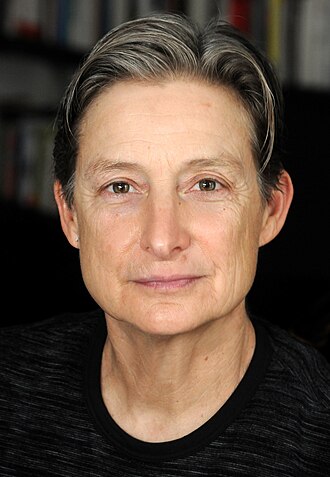
American philosopher; central figure in queer theory and gender studies. Gender Trouble (1990) transformed the humanities by proposing that gender is not a fixed identity, but a performance.
Born in Cleveland, Ohio, in 1956, Butler completed her doctorate in philosophy at Yale University in 1984 with a dissertation on the French reception of Hegel. Her intellectual formation draws on French existentialism, phenomenology, and post-structuralism — a combination that enabled her to interrogate categories typically treated as natural, such as “sex,” “gender,” and “subject,” in terms of their historical production. The central problem driving her work is: how do cultural norms fabricate bodies and identities that pass as natural? This question places her at the intersection of continental philosophy, feminist theory, and minority politics.
The impact of Gender Trouble was immediate and lasting: together with Eve Sedgwick, it founded queer theory as an academic discipline and directly shaped LGBT movements in the decades that followed. In Bodies That Matter (1993), Butler deepened her analysis of sex as a discursive construction and answered critics who accused her theory of ignoring the materiality of the body. Later, in Frames of War (2009), she expanded her scope to a political philosophy of vulnerability, linking gender, race, and migration under the concept of precariousness. Her influence extends from academic philosophy to social movements, law, and gender-equality policy.
Key Concepts
- Performativity of gender: gender is not what we are (substance), but what we do — a set of repeated acts, citations of norms, gestures and discourses that produce the effect of a natural essence. There is no gender identity behind gender acts
- Citationality: performativity is not conscious theatrical performance — it is compulsory citation of norms that preexist the subject; the subject does not freely choose its gender (against vulgar readings)
- Heterosexual matrix: system of norms that prescribes sex-gender-desire as coherent and aligned; the queer and the trans are the bodies that the norm excludes to constitute itself — the “abjected”
- Precariousness (Frames of War, 2009): lives are not equally grievable — politics determines which lives count as lives; precarious lives (racialized, queer, migrants) are those whose mourning is denied
- Critique of essentialist feminism: there is no “woman” as a stable political subject prior to politics — the identity “woman” is produced by feminist politics itself; this does not invalidate feminism, but complexifies it
Influenced by
- Simone de Beauvoir — “one is not born a woman, but becomes one” (starting point)
- Foucault — power, discourse, production of the subject
- Derrida — performativity and citationality
- J.L. Austin — theory of speech acts
- Hegel — recognition and intersubjective desire
Influenced
- Queer theory (Eve Sedgwick, Lee Edelman)
- Trans studies and non-binary identities
- Political philosophy of precariousness
- Contemporary feminisms (intersectional, queer, decolonial)
Works
Gender Trouble (1990); Bodies That Matter (1993); The Psychic Life of Power (1997); Excitable Speech (1997); Frames of War (2009); Notes Toward a Performative Theory of Assembly (2015).
See also
Twentieth-Century Philosophy