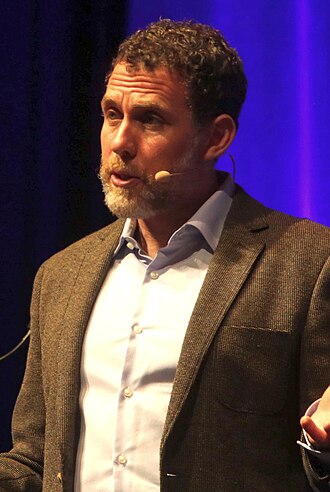
Joshua Greene (b. 1974) is a professor of psychology and director of the Moral Cognition Laboratory at Harvard University. His work stands at the intersection of moral philosophy, experimental psychology, and cognitive neuroscience, and it represents one of the most prominent efforts in the empirical turn within contemporary ethics. Greene does not merely describe how people reason about moral questions; he uses that data to defend an explicit normative claim — that utilitarianism, or more precisely what he calls “deep pragmatic utilitarianism,” is the most defensible theory for adjudicating conflicts among groups with incompatible value systems.
The central question structuring his research is: why do reasonable people reach opposing moral verdicts when faced with the same facts? His answer draws on dual-process theory. The moral mind operates through two competing systems. The first is fast, automatic, and affective, generating intuitive responses — in particular, strong aversion to causing direct physical harm to another person. The second is slow and deliberative, weighing consequences through instrumental reasoning. Greene’s thesis, supported by functional neuroimaging (fMRI) studies of moral dilemmas, is that characteristic deontological intuitions — such as the prohibition on pushing someone onto the trolley tracks to save five lives — are largely affective responses shaped by evolution for contexts of close, personal interaction, and that they carry no privileged epistemic authority when applied to large-scale abstract dilemmas. This “genetic debunking” argument is, however, the object of serious philosophical criticism: authors such as Selim Berker and Frances Kamm contend that a causal explanation of an intuition does not undermine its justificatory force, and that Greene commits a fallacy by drawing normative conclusions from descriptive data.
Key Concepts
- Dual-process theory — moral cognition involves two systems: System 1, fast and emotional, generating automatic intuitions; and System 2, slow and deliberative, performing consequentialist calculation. The tension between them explains the systematic moral disagreements observed in experiments.
- “Personal” vs. “impersonal” dilemmas — in Greene’s experiments, dilemmas requiring direct physical contact with a victim (such as the “footbridge” variant of the trolley problem) activate the emotional system with greater intensity than impersonal dilemmas (such as the “switch” variant), producing measurably distinct response patterns in fMRI studies.
- Debunking argument against deontological intuitions — the evolutionary and affective origins of certain intuitions (e.g., the prohibition on killing directly) do not grant them moral authority when applied beyond the context for which they were selected. This is not a proof that deontology is false; it is a challenge to the presumption of reliability of those intuitions in particular cases.
- Deep pragmatic utilitarianism — Greene argues in Moral Tribes (2013) that utilitarianism functions as a “metamorality” for resolving intergroup conflicts, because it provides a common currency — welfare — that transcends parochial value systems.
- Experimental moral neuroethics — the use of neuroimaging as a tool for investigating the cognitive and affective bases of moral judgment, contributing to an empirical understanding of ethics without positing a unitary “moral faculty.”
Influenced by
- Peter Singer — utilitarianism and welfare-based ethics
- John Stuart Mill — classical consequentialist tradition
- David Hume — the role of emotions in moral judgment
- Daniel Kahneman — dual-process theory applied to cognition generally
- Judith Jarvis Thomson — philosophical formulation of trolley dilemmas
Influenced
- Experimental moral psychology (Jonathan Haidt, Fiery Cushman)
- Neuroethics and applied bioethics
- Contemporary debates on the validity of moral intuitions in analytic philosophy
- Researchers examining the role of emotions in moral deliberation
Works
- “An fMRI Investigation of Emotional Engagement in Moral Judgment” (article in Science, 2001) — founding study linking neuroimaging and moral dilemmas
- “The Secret Joke of Kant’s Soul” (chapter in Moral Psychology, ed. Sinnott-Armstrong, 2008) — expanded version of the dual-process thesis applied to deontology
- Moral Tribes: Emotion, Reason, and the Gap Between Us and Them (Penguin Press, 2013) — synthesis work presenting deep consequentialism as a cross-cultural metamorality
See also
Philippa Foot, Judith Jarvis Thomson, Peter Singer, Bernard Williams