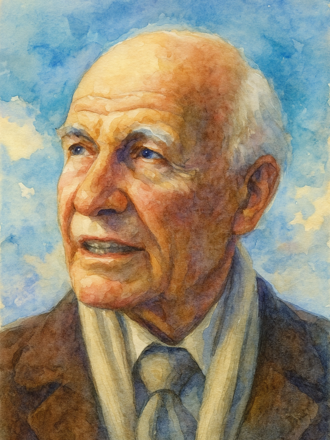
Josef Pieper was born in Elte, in Westphalia, on 4 May 1904 and died in Münster on 6 November 1997. He studied philosophy, law and sociology at Münster and Berlin and took his doctorate in 1928. He worked first in sociological research and as an independent writer and, from 1959/1960, was full professor of philosophical anthropology at the University of Münster, where he taught for many years. In 1981 he received the Balzan Prize for Philosophy. His work, written in a deliberately clear style averse to academic jargon, draws chiefly on Thomas Aquinas, read in dialogue with Plato and Aristotle, and addresses questions of everyday life: work, free time, the virtues, hope, language.
Key Concepts
- Leisure (Muße) and worship — in Muße und Kult (1948; English Leisure, the Basis of Culture, 1952, with an introduction by T. S. Eliot), Pieper argues that culture originates in leisure understood not as a mere pause to recover working strength but as a contemplative attitude of receptivity to reality, historically tied to worship and festival. He criticizes what he calls the “world of total work,” in which the human being is reduced to the function of worker.
- Philosophizing as wonder — in Was heißt Philosophieren? (1948), he takes up from Plato and Aristotle the thesis that philosophy begins in wonder (thaumazein) before the real, and that the philosophical act transcends utilitarian interest.
- Cardinal virtues — in studies of prudence (1937), justice (1953), fortitude and temperance, collected in Das Viergespann (1964), he follows Aquinas in treating prudence as the virtue that shapes the others, since it relates action to reality; Pieper’s ethics is in this sense grounded in the truth of being, the theme of his early book Die Wirklichkeit und das Gute.
- Theological virtues — studies of faith, hope and love, among them Über die Hoffnung (1935). On hope he uses the image of the homo viator, the human being on the way, which also marks the work of Gabriel Marcel.
- Language and power — in Missbrauch der Sprache, Missbrauch der Macht, taking up the Platonic critique of sophistry, he argues that the corruption of the word, when it ceases to serve truth, is tied to the abuse of power.
Influenced by
- Thomas Aquinas, the subject of his Hinführung zu Thomas von Aquin (1958) and other studies
- Plato and Aristotle, in particular on philosophical wonder and the virtues
- The patristic and medieval tradition in general, which Pieper discusses in Scholastik (1960)
Influenced
- The contemporary debate on leisure, work and education, in which Muße und Kult remains widely cited
- The revival of virtue ethics in German- and English-language Catholic thought
- The popularization of Thomist thought for a non-specialist readership, through translations into many languages
Works
Die Wirklichkeit und das Gute; Über die Hoffnung (1935); Traktat über die Klugheit (1937); Muße und Kult (1948); Was heißt Philosophieren? (1948); Über die Gerechtigkeit (1953); Hinführung zu Thomas von Aquin (1958); Scholastik (1960); Das Viergespann (1964); Missbrauch der Sprache, Missbrauch der Macht.
See also
Étienne Gilson, Jacques Maritain, Romano Guardini, Gabriel Marcel, Antonin Sertillanges