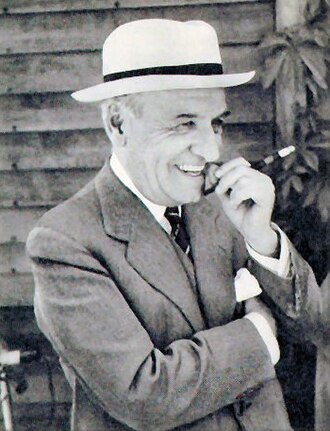
José Ortega y Gasset was born in Madrid on 9 May 1883 and died in the same city on 18 October 1955. He studied in Madrid and in Germany, above all at Marburg, where he came into contact with the Neo-Kantianism of Hermann Cohen and Paul Natorp. In 1910 he took the chair of Metaphysics at the Universidad Central in Madrid. He was the leading figure of the so-called Generation of 1914, founded the Revista de Occidente (1923), and took part in Republican public life. With the outbreak of the Civil War he left Spain in 1936 and lived in exile (France, Argentina, Portugal) until his return in the second half of the 1940s; in 1948 he founded the Instituto de Humanidades in Madrid together with Julián Marías.
His philosophical project starts from a critique of both idealism and naive realism. In Meditaciones del Quijote (1914) appears the formula that sums up his position: “Yo soy yo y mi circunstancia, y si no la salvo a ella no me salvo yo” (“I am myself and my circumstance, and if I do not save it, I do not save myself”). Human life, for Ortega, is the radical reality: the encounter of a self with a concrete surrounding that constitutes it and that it must transform. From this thesis follows vital reason, developed in works such as El tema de nuestro tiempo (1923) and En torno a Galileo (1933), and later historical reason (Historia como sistema, 1941), according to which understanding the human being requires narrating his trajectory rather than defining him as a fixed substance.
In the social and political sphere, España invertebrada (1921) diagnoses the fragility of Spanish national cohesion, and La rebelión de las masas (1930, collecting articles published from 1926) analyses the “mass man”: the individual who, demanding nothing of himself, feels identical to everyone else and rejects the authority of qualified minorities. The book is among the most widely read works of Spanish philosophy and has been criticized, among other things, for its elitist tone.
Key Concepts
- Circumstance — the concrete world in which each life unfolds; life is always “I and my circumstance” (Meditaciones del Quijote, 1914).
- Vital reason — reason not as an abstract faculty but as a function of life, in its service; for Ortega, a way beyond rationalism and relativism.
- Historical reason — understanding the human being through his history rather than through a fixed nature (Historia como sistema, 1941).
- Perspectivism — each individual standpoint reveals an aspect of truth, which is composed through the sum of perspectives, without this implying relativism (El tema de nuestro tiempo, 1923).
- Ideas and beliefs — beliefs are the ground on which one lives; ideas are what one has or produces (Ideas y creencias, 1940).
- Mass man — the dominant human type in mass society, described in La rebelión de las masas.
Influenced by
- Nietzsche — the idea of perspective and the valuation of life
- Husserl — phenomenology, which Ortega encountered early and from which he later distanced himself
- Wilhelm Dilthey — the notion of life and historicity
- Marburg Neo-Kantianism (Cohen, Natorp), his starting point and later object of critique
- Heidegger — a relationship of dialogue and dispute over the priority of themes such as concrete existence
Influenced
- Julián Marías — disciple and principal continuator of ratiovitalism
- Xavier Zubiri — trained with Ortega in Madrid but developed a system of his own
- María Zambrano — a disciple whose poetic reason grew out of both dialogue and divergence with her teacher
- José Gaos and Manuel García Morente — disciples who spread his work in Spain and Latin America
Works
Meditaciones del Quijote (Meditations on Quixote, 1914); España invertebrada (Invertebrate Spain, 1921); El tema de nuestro tiempo (The Modern Theme, 1923); La rebelión de las masas (The Revolt of the Masses, 1930); En torno a Galileo (1933); Ideas y creencias (1940); Historia como sistema (History as a System, 1941); posthumous: ¿Qué es filosofía? and El hombre y la gente (1957).
See also
Miguel de Unamuno, Xavier Zubiri, María Zambrano, Heidegger, Husserl